

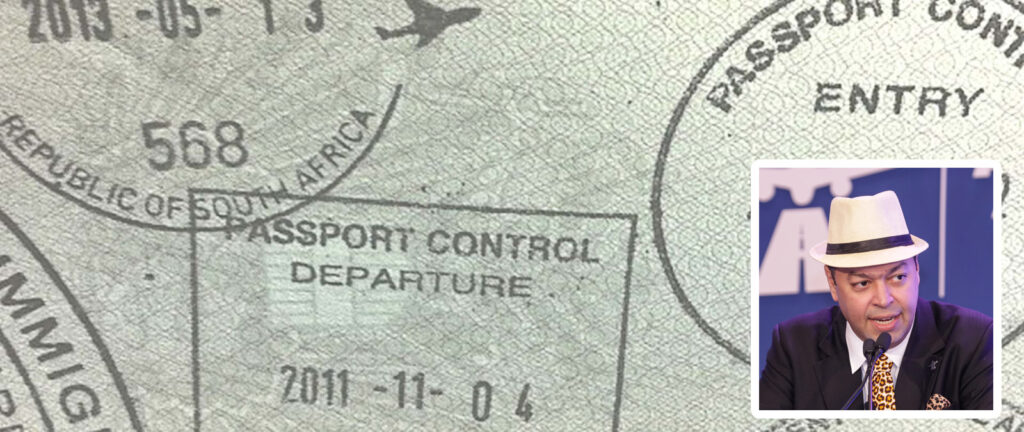
I set a new world record recently — an unwanted one, though. I got refused visas for three different African countries in a single day.
The morning started with a refusal from Namibia. I was supposed to attend a conference there, but the covering letter in my visa application was not properly addressed to the recently renamed “Ministry of Home Affairs, Immigration, Safety and Security.” Of course, that offended someone sufficiently enough to reject the entire application. Strike One!
Later in the day, I got an email from South Africa’s Department of Home Affairs. My eVisa application, submitted seven weeks earlier for a conference that had long since ended without my participation, had finally been processed. And it had been rejected because the dates of that conference had now passed. Chicken, meet egg. Strike Two!
Finally, the afternoon brought me my third rejection of the day. This one from Botswana. And the reason was a real doozy: “You must not be smiling in the photograph submitted. You can resubmit when you are not smiling.” Well, no risk of smiles after the day I’ve just had. Strike Three!
Now, of course, this is not a typical day. Less tenacious people would have given up long before this. However, seemingly ridiculous and onerous visa policies remain a daily nuisance for those of us who live, work and travel in Africa.
It’s not just regular guys like me who have this issue, though. Aliko Dangote, the continent’s richest man, claims to require visas to enter 35 different African countries. This scenario is particularly striking when compared to his European counterparts, who can enter most of these countries visa-free. This discrepancy underscores the barriers that African businesspeople and tourists face within their own continent, which is in stark contrast to the seamless travel Europeans enjoy both at home, and relatively so even in Africa. This situation not only impedes business and tourism but also reflects a deeper issue of regional disintegration.
Even when African countries make the news with high-profile changes to ostensibly simplify visa policy, there is often a range of loopholes hidden in the fine print. Malawi recently announced a visa waiver for 79 countries amid much acclaim from tourism stakeholders. Yet, when you look at the list of countries that benefit from this waiver, you see that citizens of over half of its fellow African Union member states still need to apply for a visa in advance. This selective approach to visa waivers underscores the ongoing reluctance to fully embrace regional integration.
President Ruto of Kenya made headlines in December for “abolishing” all visas. In his own words, “it (will) no longer be necessary for any person from any corner of the globe to carry the burden of applying for a visa to come to Kenya.” Wow, inspiring words. Except that instead of applying for a visa, you now had to fill out basically the same form you did before to apply for an “Electronic Travel Authorisation (ETA).” This included people like South Africans and Ghanaians who could previously just hop on a plane and fly to Kenya. No visa needed though, just this new “not a visa.” No transformative policy after all, just a marketing and rebranding exercise. Terms and conditions apply.
Lesotho is another fascinating country. You might think that a tiny landlocked paradise would try to make it easier for visitors to come spend their money. You would be wrong. After experimenting with eVisas immediately before the COVID-19 pandemic, they have scrapped that system and now have a charmingly retro “email us and ask for a visa” system. I’ve visited over 80 countries all over the world, but this is the first one where I have to submit a doctor’s note certifying that I am healthy enough to visit Lesotho as a tourist! One really has to question who came up with that requirement, what prompted it, and if it really helps encourage tourists to visit!
If Africa is to truly benefit from increased tourism and business travel, there needs to be a paradigm shift from a default “no” to a default “yes” when it comes to welcoming genuine visitors. You can’t invest hundreds of thousands of dollars to attract a conference to your country, but then block people from attending that same conference because some low-level bureaucrat got their knickers in a twist over a perceived protocol snub.
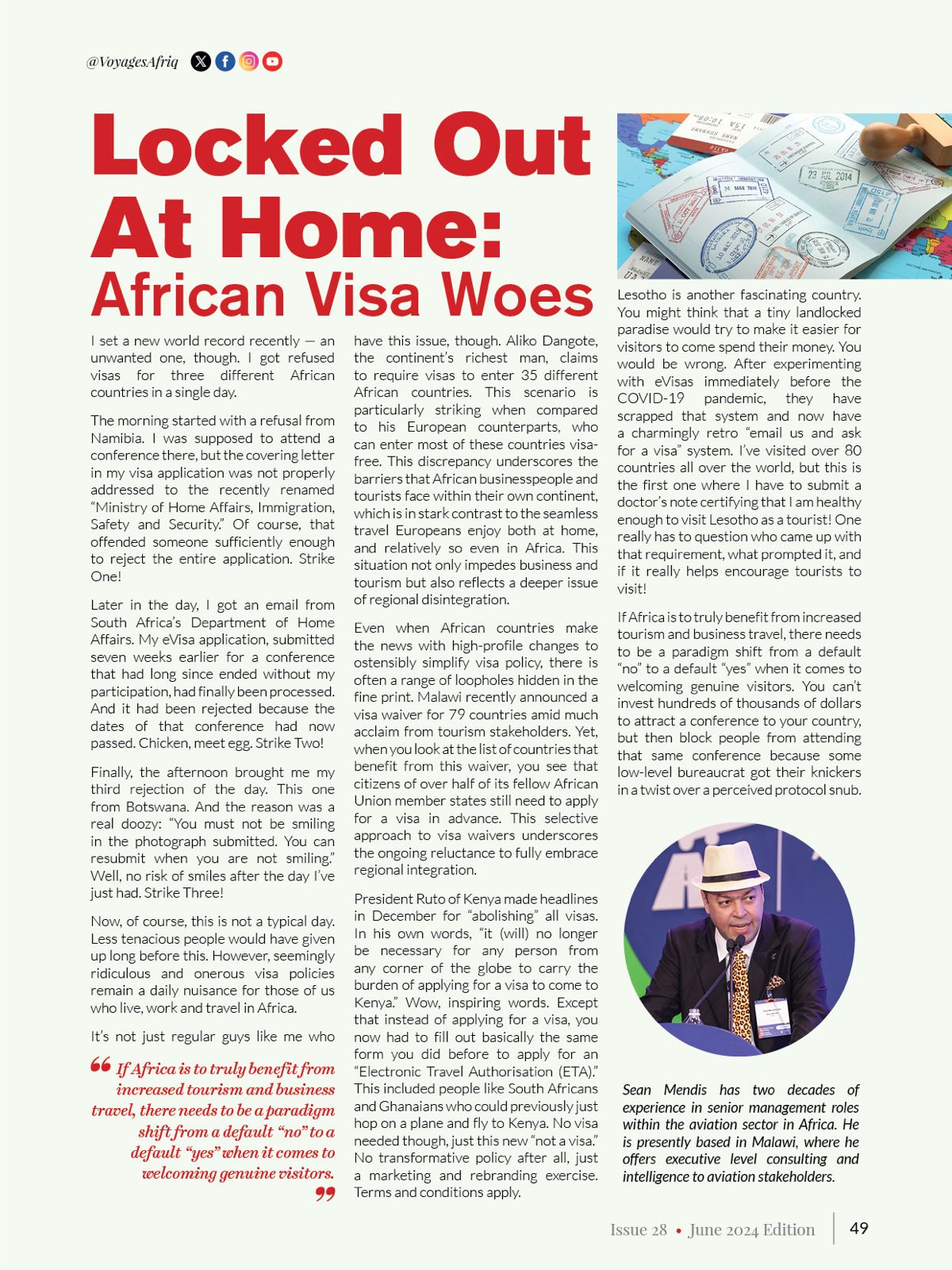
Sean Mendis has two decades of experience in senior management roles within the aviation sector in Africa. He is
presently based in Malawi, where he offers executive level consulting and intelligence to aviation stakeholders.
This Article was first published in the June 2024 of VoyagesAfriq Travel Magazine