
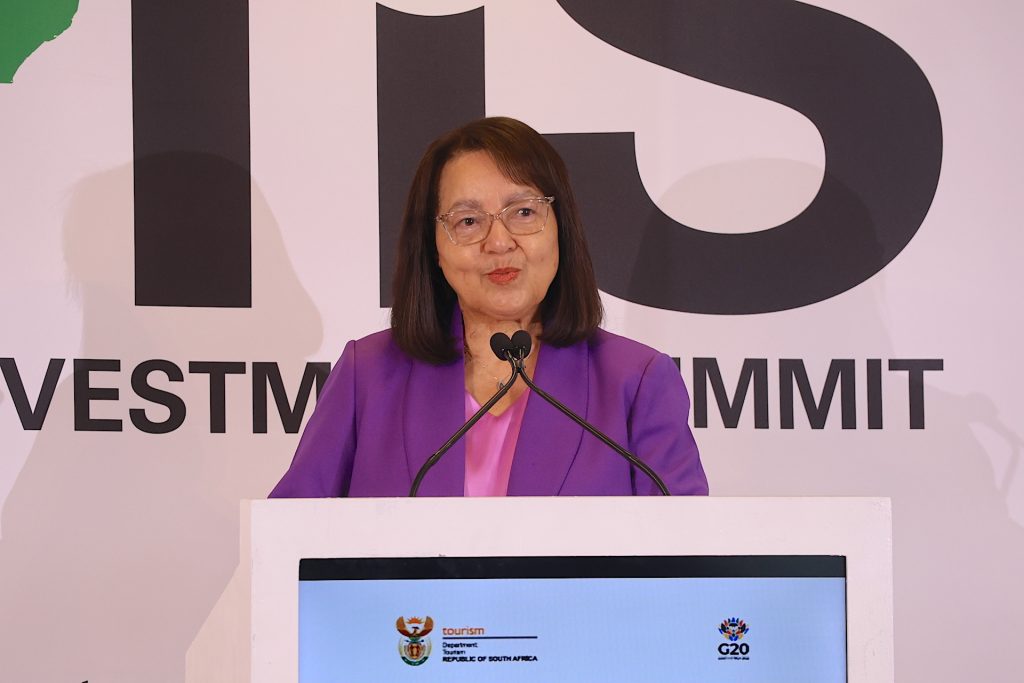
Photo: South Africa’s Minister of Tourism Patricia de Lille
South Africa has rolled out eight flagship, investment-ready tourism projects worth nearly R1 billion (One billion Rands) at the inaugural G20 Tourism Investment Summit, signalling its readiness to attract global capital and unlock the sector’s full potential.
Delivering the official opening address on Wednesday, 10th September, Minister of Tourism Patricia de Lille told delegates that the projects, spanning both public and private sectors, were designed to offer strong returns for investors while uplifting communities.
Among the headline ventures is the God’s Window Skywalk in Mpumalanga, seeking R200 million ($10.4 million), and the Hole in the Wall Resort in the Eastern Cape, which requires R141 million ($7.9 million). Together with six other projects, they represent a portfolio of opportunities aimed at enhancing South Africa’s tourism infrastructure, diversifying attractions, and driving inclusive growth.
“These are bankable projects with high impact, but they are just the beginning,” Minister de Lille said. “Our national pipeline is rich, diverse, and growing. We are not only a nation of immense tourism potential but also a gateway to Africa.”
Policy shifts unlock growth
De Lille highlighted that recent regulatory reforms had paved the way for innovative financing. Since June 2025, amendments to National Treasury Regulation 16 for Public-Private Partnerships have allowed for more flexible investment models, including blended finance, crowdfunding, and Design-Build-Operate arrangements.
“This creates a fertile environment for shovel-ready projects,” she explained. “With the right mix, we can build infrastructure, create jobs, and uplift communities all at once.”
Tourism as a growth engine
Tourism already contributes at least 8.5% to South Africa’s GDP, with July 2025 alone recording over 880,000 international arrivals — a 26% increase year-on-year. According to UN Tourism, South African tourism startups attracted more than $39 million in venture capital between 2019 and 2024, representing more than half of Africa’s total.
To further boost investor confidence, the Summit also saw the launch of the “Tourism Doing Business: Investing in South Africa Guidelines”, developed in collaboration with UN Tourism. The guidelines aim to provide clarity, transparency, and certainty for potential investors.
Private sector confidence growing
The Minister pointed to major private sector commitments as evidence of investor confidence, including the V&A Waterfront’s R20 billion Granger Bay precinct development in Cape Town and Club Med’s new resort on KwaZulu-Natal’s Indian Ocean coastline.
“These pioneers are proof that South Africa is ready, open, and serious about investment,” de Lille noted.
Youth and skills at the centre
With 56% of South Africans under the age of 30 and an adult literacy rate of 95%, de Lille emphasised that human capital was one of the country’s strongest assets. She welcomed UN Tourism’s announcement of 100 scholarshipsaligned with demand-led skills development, ensuring the tourism sector is equipped with the workforce of the future.
Opening doors for global visitors
South Africa is also moving to improve travel access. The Department of Home Affairs will roll out an Electronic Travel Authorisation system before the end of September, streamlining visa processes for tourists from around the world.
Positioning South Africa as a sports tourism destination is also on the agenda, with bids and hosting rights secured for events ranging from Formula 1 at Kyalami and the LIV Golf tournament at Steyn City to the 2027 ICC Cricket World Cup.
Minister de Lille concluded with a direct call to investors:
“Every rand or dollar invested here means jobs for young South Africans. Every partnership formed will help us transform tourism into a driver of inclusive, sustainable prosperity. South Africa is a nation at work, and we are about action. Partner with us, and together we can deliver a bold new chapter in tourism investment.”