

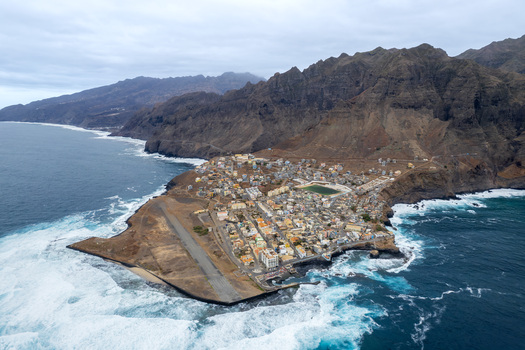
The Government of Cabo Verde has moved decisively to shore up Santo Antão’s position as a leading nature-tourism destination. Through coordinated interventions by the Ministry of Tourism and Transport (MTT) and the Institute of Tourism of Cabo Verde (ITCV), and with World Bank financing under the Resilient Tourism and Blue Economy Development Project, authorities have delivered tangible improvements to the island’s pedestrian network and visitor infrastructure measures designed to widen the tourism offer, increase resilience and support local livelihoods.
The response follows concerns set out in recent reporting about trail conditions at the outset of the high season. In practical terms, the programme has rehabilitated and signposted 47 kilometres of neighborhood trails, with approximately 30,000 accounts invested in that phase of works across the three municipalities of Porto Novo, Ribeira Grande and Paul. The rehabilitation is complemented by a comprehensive mapping exercise: an island-wide network totaling 309.1 kilometres has been charted and organized into a main route with 12 trunks, 16 ancillary routes and 15 cross-link paths. To improve on-the-ground wayfinding, teams installed 55 information panels, placed 280 directional arrows, and ink markings at strategic locations.
Digital dissemination is a deliberate element of the plan. The newly mapped routes appear on six specialist outdoor platforms Wikiloc, OutdoorActive, AllTrails, Komoot, Visorando and Trail Trace under the profile “Percursursos Santo Antão_Cabo Verde“, making the island’s trails discoverable to international hiking communities and adventure travellers.
The programme now moves into a second investment phase. The UGPE Special Projects Management Unit for further rehabilitation works and the construction of lookout towers is preparing tender documents. Plans indicate the procurement of two to three lookout towers per municipality, while the next tranche of trail investments carries budgets that exceed 30,000 accounts in each council: Porto Novo (37,000 accounts), Ribeira Grande (42,000 accounts) and Paul (approximately 32,000 accounts). These follow-on works are intended both to consolidate recent gains and to create new vantage points that enhance the visitor experience and disperse tourism benefits across communities.
Capacity building and governance form a second pillar. Santo Antão is being supported by the Technical Assistance Project to Support Hiking Tourism in Cabo Verde: Regulations, Rules, Empowerment, Governance and Marketing a targeted programme delivered by a specialist adventure-tourism firm and funded at a scale reported as exceeding fifty thousand (local currency). The assistance package will strengthen regulatory frameworks, clarify operational rules, and equip local stakeholders from guides to small enterprises with governance, marketing and business skills tailored to sustainable hiking tourism.
Parallel investments from the Social Sustainability Fund of Tourism are already active on the island, focusing on accessibility improvements, urban retraining and guide training with a hiking emphasis. These interventions are aligned with the ongoing Tourist and Environmental Valuation Program of Rural Villages, which channels targeted upgrades to village infrastructure and market access in the three municipalities.
Taken together, the works on Santo Antão reflect a clear strategic logic: make trails safe, legible and market-ready; widen the economic footprint of nature tourism by linking digital discovery with physical infrastructure; and build local capacity so that communities capture a larger share of tourism returns. For operators and visitors, the combined effect should be itineraries that are more diverse, clearer route information and new products from viewpoint attractions to community-led services that extend stays and spend on the island.
With these combined initiatives, Santo Antão now counts a rehabilitated and signposted pedestrian network, new digital visibility across global hiking platforms, and planned investments in lookout towers and additional trails. Alongside technical assistance and community training, the island is positioned with expanded infrastructure and governance tools that reinforce its role as one of Cape Verde’s leading destinations for nature-based tourism.