
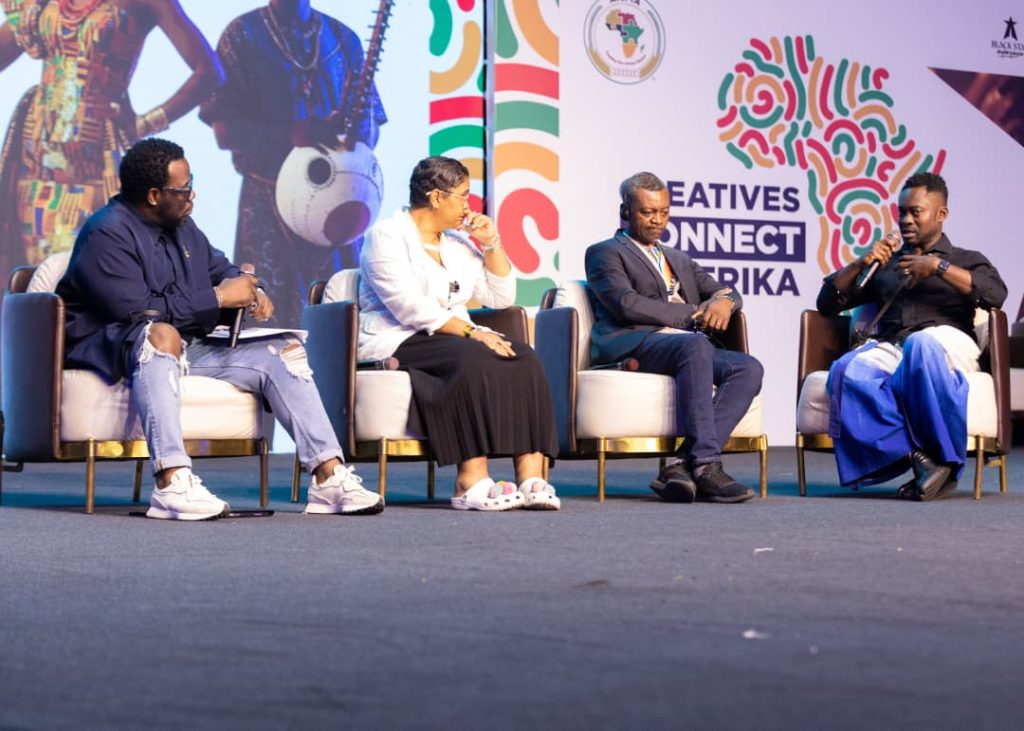
The official opening of Creatives Connect Afrika at La Palm Royal Beach Hotel moved the conversation on Africa’s creative economy from aspiration to action, as heads of state representatives, continental institutions, diplomats, investors and creative entrepreneurs convened to endorse a practical programme for scaling film, music, fashion and related cultural industries under the African Continental Free Trade Area.
Organized by the AfCFTA Secretariat, the Black Star Experience Secretariat and Africa Tourism Partners, the forum opened amid strong political and institutional support. Delivering an address on behalf of H.E. John Dramani Mahama, Rex Owusu Marfo, Coordinator of the Black Star Experience, set out a clear policy architecture and financial commitment intended to accelerate sectoral growth. As Mr Marfo read, “They are the energies of our economic future, we stand at the cusp of a new African Renaissance,” and he urged immediate, coordinated action to turn creative expression into sustainable economic value. The presidential address proposed a focused agenda for investment, digital and physical infrastructure, intellectual property protection, and market access, and announced seed capital measures to leverage private investment for the sector.
In a keynote delivered by video, AfCFTA Secretary-General Wamkele Mene framed the forum as an operational moment for AfCFTA’s trade in services agenda. “Today, we gather not only to celebrate Africa’s extraordinary creative and cultural potential, but to charge a pathway that transforms commitments under the AfCFTA into concrete investment, jobs and prosperity,” he said, highlighting the protocol on trade in services as the mechanism through which film, music, fashion and digital content can move and monetize across borders. Mr Mene emphasized harmonized IP frameworks, digital trade acceleration and simplified artist mobility as preconditions for scaling the continent’s creative exports.
Sedem Charles Hottor, speaking on behalf of Hon. Abla Dzifa Gomashie, Minister of Tourism, Culture and Creative Arts, further underlined the Government of Ghana’s commitment. Mr Hottor reminded delegates, “African creativity is shaping properties in music, films, fashion, visual arts, design, cuisine, digital media in massive cultural experiences all across the world,” and called for policy reforms to expand market access, protect cultural assets, and leverage tourism as a growth engine for creative enterprises.
The morning and midday programme expanded on these strategic priorities through high-level interventions and sectoral masterclasses. Mr. Kwakye Donkor, Chief Executive Officer of Africa Tourism Partners, reinforced the symbiotic link between tourism and creative industries, urging delegates to treat the two sectors as interdependent components of destination competitiveness. H.E. Jonas Claes, Deputy Head of Delegation, European Union to Ghana, reaffirmed EU technical and financial support for regional integration and cultural exchange.
Thought-leadership dialogues examined practical pathways for cross-sector collaboration and trade. The session on Expanding Africa’s Creative Economy through Tourism, Film, Media and Digital Innovation Linkages convened policymakers and private sector leaders to unpack logistics, e-transport, distribution services and the interoperability of digital platforms. Panelists stressed the need for harmonized beneficiary platforms that reliably track usage, allocate royalties and ensure creators benefit wherever their work is consumed across the continent.
A fireside chat, ‘Unleashing the Power of Storytelling,’ reframed storytelling as an economic tool, not only a cultural practice. Participants discussed how authentic narratives, supported by robust IP protection and digital distribution, can create demand, drive tourism interest and catalyse intra-African trade in creative content. The Inspiring Global Attraction session deepened that line of inquiry, exploring how films, music, fashion and cultural experiences build Brand Africa’s soft power, and marshal foreign direct investment and export opportunities.
Panel contributions highlighted recurring technical obstacles, notably fragmented licensing regimes, weak metadata, uneven digital infrastructure and constrained access to finance. Delegates from Botswana, Kenya, Nigeria, Cape Verde, Cote d’Ivoire, Morocco, Tanzania and others shared country-level strategies for leveraging AfCFTA protocols to overcome scale limitations, particularly for markets with smaller domestic demand.
Practical solutions surfaced across multiple sessions, including: interoperable cross-border payment systems, metadata standardization, alternative financing instruments tailored to creative cashflows, infrastructure investment for production and rehearsal spaces, and capacity building for collective rights management organizations. The consensus was clear, policy leadership must be matched by private sector innovation and targeted finance to convert creative output into durable economic returns.
Cultural performances and exhibitions punctuated proceedings, underscoring the nexus between heritage and commerce, while the latter part of the opening day featured film screenings that showcased the continent’s narrative range and production capacities. Delegates and exhibitors used the exhibition floor to highlight authentic Made-in-Africa products and the potential for creative goods to support tourism value chains.
Key takeaways from the opening day included a call for a convergent public-private architecture focused on six pillars, innovative financing, integrated market access, digital distribution highways, enabling infrastructure, technology and data sovereignty, and seamless cross-border payments. These priorities were articulated repeatedly as the necessary foundation for creators to retain value, become equity holders in their work, and participate fully in a single continental market.
As the forum advances, the final day’s agenda will probe mobility frameworks for creative professionals, financing mechanisms for creative enterprises, digital transformation through AI and VR, and a fashion runway that will spotlight design-led trade opportunities. Creatives Connect Afrika has, in its opening act, signaled a unified mandate: to move beyond rhetoric and build the platforms, policies and partnerships that will let Africa’s storytellers, designers and musicians thrive across the continent and on the world stage.