

The 2026 Hotel Chain Development Pipelines in Africa report by W Hospitality Group reveals a record 123,846 rooms across 675 hotels and resorts. This represents year-on-year growth of 18.6%, or 12.2% on a same-store basis.
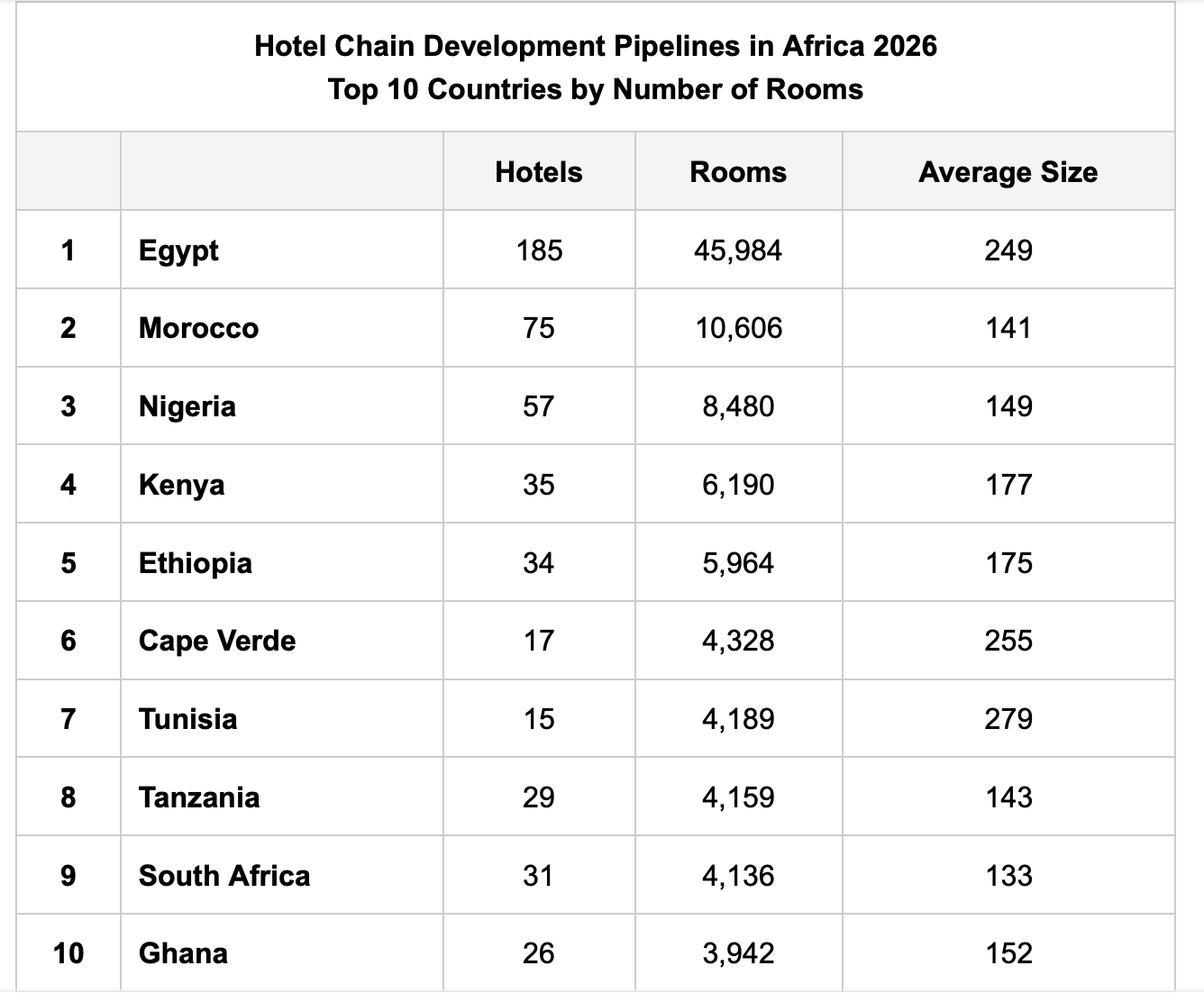
While the overall pipeline reflects strong continental expansion, the data show that development activity is increasingly concentrated in a small number of dominant markets. The top ten countries now account for 79% of total pipeline rooms and more than 75% of new signings, reinforcing their growing influence on Africa’s hotel development trajectory.
Egypt leads with 45,984 rooms across 185 properties – more than one third of the entire African pipeline and over four times the number in second-placed Morocco, which has 10,606 rooms. Together, Egypt and Morocco account for more than 45% of total pipeline rooms, and their share continues to grow due to the high volume of new signings. Egypt alone recorded 39 new deals last year and anticipates 33 openings in 2026, reinforcing its sustained development momentum.
As Trevor Ward, Managing Director of W Hospitality Group, comments, “The data clearly show that Africa’s hotel development story is being driven by a handful of high-performing markets, with Egypt firmly at the forefront in both signings and projected openings.”
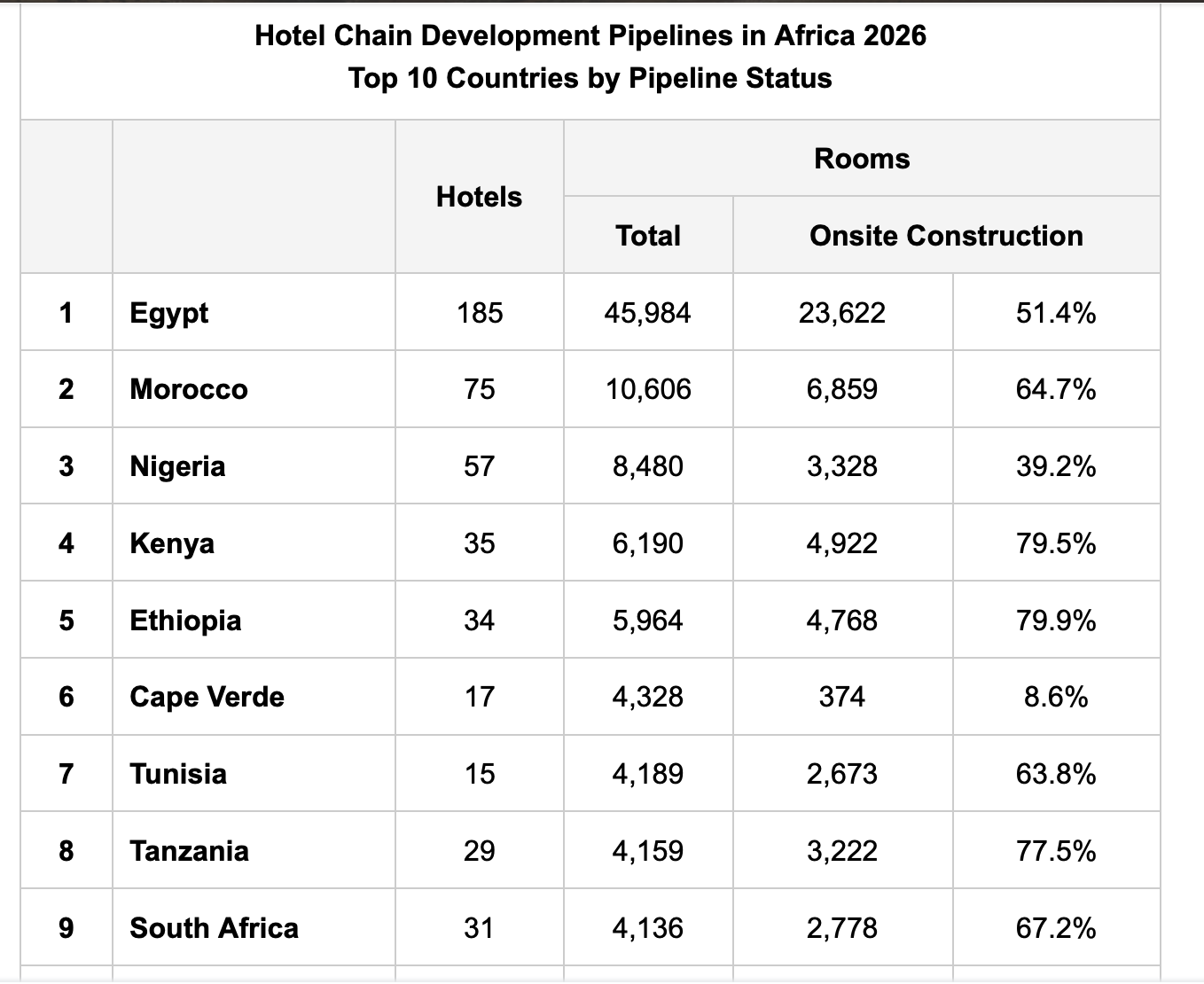
Beyond overall scale, the pipeline status data reveal that execution momentum is currently strongest in East Africa. Ethiopia and Kenya both have nearly 80% of their rooms under construction, closely followed by Tanzania at 77.5%.
This compares with significantly lower proportions of projects under construction in markets such as Nigeria and Cape Verde. While North Africa dominates in overall volume, East Africa is leading in terms of projects actively progressing toward completion and near-term delivery.
As Trevor Ward comments, “What stands out this year is the strength of East Africa in terms of projects moving forward. Kenya, Ethiopia and Tanzania show some of the highest construction ratios on the continent, which suggests that this is where we are likely to see new supply coming through in the short to medium term.”
At the operator level, development activity remains highly concentrated among a small number of global brands. Marriott International leads with 31,782 rooms, followed by Hilton and Accor, with the Big Five global chains – including IHG and Radisson Hotel Group – accounting for around 80% of all pipeline hotels and rooms across Africa.
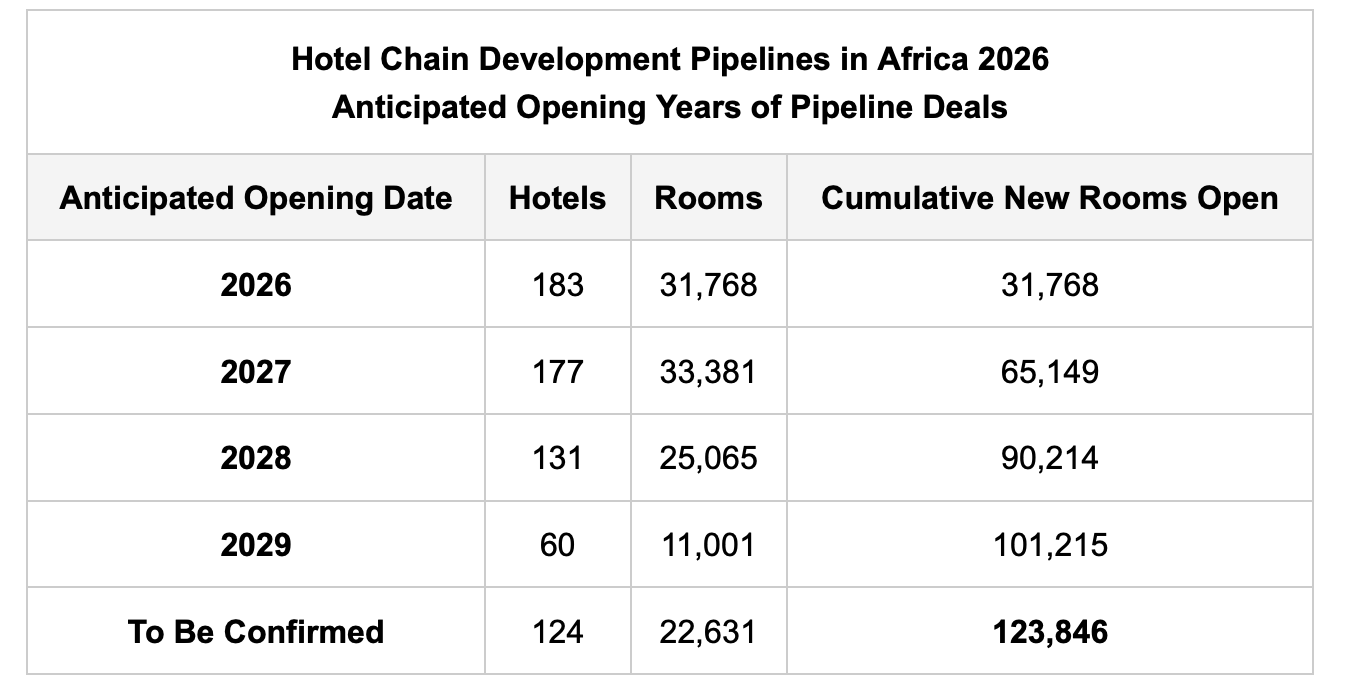
Although more than 65,000 rooms are forecast to open in 2026 and 2027, historical actualisation rates suggest delivery may fall short of projections, highlighting the ongoing gap between ambition and execution.
A deeper analysis of these trends – including signings, construction progress and anticipated openings – will be presented at the Future Hospitality Summit Africa, taking place from 31 March to 1 April in Nairobi.