

Africa’s hospitality sector is entering a decisive new phase – one marked not only by growth, but by structural evolution. Once viewed primarily through the lens of tourism, hospitality is increasingly being recognised as a core real estate asset class, shaping investment strategies, urban development, and mixed-use precincts across the continent.
From Nairobi to Cape Town, Lagos to Casablanca, hospitality is no longer confined to hotels alone. It is influencing how offices are designed, how healthcare environments are experienced, and how residential and lifestyle developments are conceptualised. This convergence reflects a broader shift: hospitality is becoming a driver of place-making and economic activation across Africa.
At the same time, Africa’s underlying fundamentals – rapid urbanisation, a growing middle class, infrastructure investment, and expanding tourism demand – continue to position the continent as one of the most compelling long-term hospitality markets globally. Yet, as industry leaders consistently emphasise, success in Africa is not guaranteed by macro trends alone. It requires deep sector expertise and an eco-system of services that support owners through the life-cycle of a hotel.
Unlike traditional real estate sectors, hospitality performance is deeply operational and the fortunes of an owner are intrinsically tied to the underlying performance of the asset This complexity demands a more integrated, specialist advisory approach – one that bridges real estate fundamentals with operational expertise.
It is within this context that Broll Property Group has announced the launch of a dedicated hospitality service line – an expansion that signals both confidence in the sector and a disciplined response to evolving client demand.

A Measured Expansion, Not a Market Play
For Malcolm Horne, Group CEO of Broll Property Group, the move into hospitality is not opportunistic. It is the result of a deliberate, long-term strategy anchored in what he describes as “strength before scale.”
“The easiest thing in business is to announce growth,” Horne notes. “The hardest thing is to deliver it with excellence.”
This philosophy has shaped Broll’s trajectory in recent years. Rather than pursuing rapid expansion, the group has focused on reinforcing its core platforms – property management, occupier services, and facilities management – across Africa. These capabilities now form the operational backbone of the business, enabling it to expand with confidence rather than compromise.
Broll’s entry into hospitality, Horne explains, is a natural extension of client needs. As investors increasingly allocate capital to hospitality assets – and as those assets become more complex – there is growing demand for advisory platforms that can navigate both real estate and operational dimensions.
“We are not expanding for appearance’s sake,” he says. “If we can’t add real value, we don’t want to do it.”
The hospitality service line will be rolled out across the continent, leveraging Broll’s existing footprint and market intelligence. Importantly, it will operate within the group’s broader integrated platform, allowing clients to access end-to-end advisory across the property lifecycle – from feasibility and development to asset management and eventual exit.
This approach reflects a broader strategic principle: expansion must deepen relevance, not dilute capability.
Africa: Opportunity, But Not Uniformity
Central to Broll’s strategy is a clear-eyed view of Africa itself. While the continent offers significant opportunity, it is not a single, homogenous market.
Each country presents its own regulatory frameworks, infrastructure realities, procurement cultures, and consumer expectations. Hospitality assets that succeed in one market may not translate seamlessly into another.
“Africa presents enormous hospitality opportunity,” Horne says, “but success here requires understanding the realities of each market – not applying a global template.”
This is where Broll’s pan-African experience becomes a competitive advantage. With decades of operational presence across multiple markets, the group brings granular, on-the-ground insight – an essential ingredient in navigating the continent’s complexity.
A Sector Redefining Itself
If the timing of Broll’s expansion is strategic, so too is its leadership appointment.
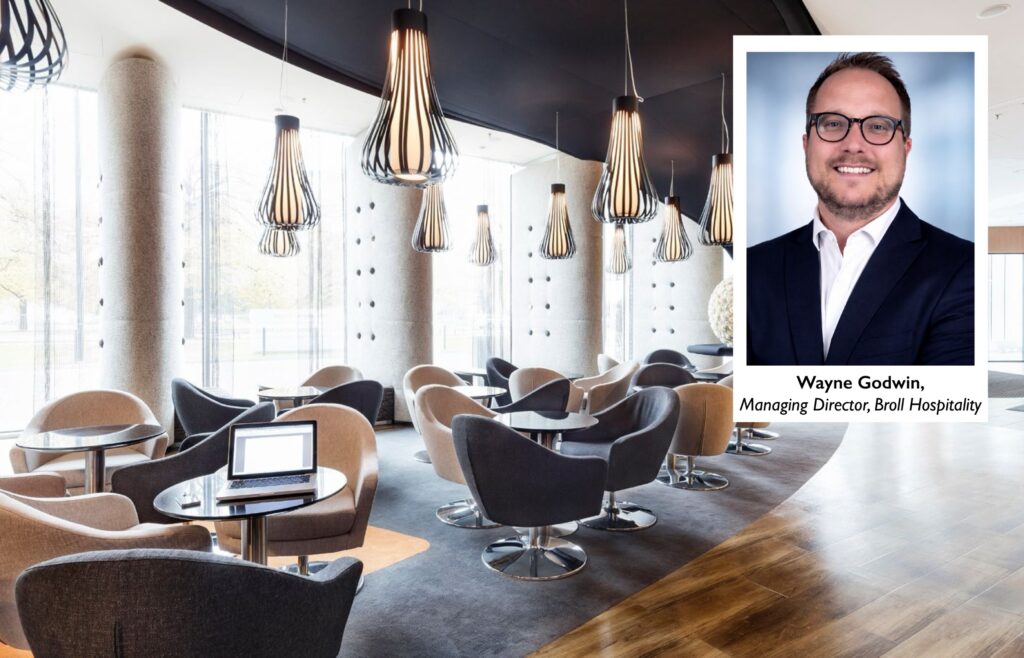
The new hospitality division will be led by Wayne Godwin, a widely respected figure in African real estate and the hospitality sector. With nearly two decades of experience and project exposure across more than 43 African countries, Godwin brings a rare combination of continental breadth and sector depth.
His perspective on the sector reflects the transformation underway.
“Several things are changing simultaneously in African hospitality,” Godwin explains. “We are seeing the asset class evolve globally, hospitality in Africa is no longer defined by traditional hotel models. Instead, it has evolved into a diverse ecosystem – spanning extended-stay products, branded residences, resorts, lodges, and lifestyle-driven developments. Each needs a nuanced approach, with an understanding of the underlying core hospitality fundamentals.”
Today’s leading hospitality assets generate significant revenue not only from rooms, but from food and beverage, co-working, wellness, conferencing, and entertainment. They are as much urban hubs as they are accommodation providers.
This shift has profound implications for investors.
“Those who see only the room count are missing most of what determines whether a hospitality asset performs,” Godwin notes.
Equally significant is the rise of authentic African identity in hospitality design and experience. Increasingly, developments that embrace local culture, architecture, and narrative are well positioned to capitalise on Africa’s bourgeoning regional and local tourism market.
Connecting Africa to Global Capital
Another critical dimension of Broll’s hospitality strategy is its ability to link African opportunities with global capital.
Through its affiliation with Cushman & Wakefield, one of the world’s largest real estate services firms, Broll is positioned to connect international investors with hospitality assets across Africa. This represents a shift in investment strategy – from primarily intra-African capital flows to a more outward-facing, globally integrated approach.
An Integrated Platform for a Complex Asset Class
Broll Hospitality is structured as a full-service advisory platform, supporting clients across the entire investment lifecycle. This includes:
- Market entry strategy and feasibility studies;
- Development and project management;
- Operator Selection & Contract Negotiation
- Asset management and owner representation;
- Valuation;
- Capital market strategy and investment sales.
This end-to-end model is important, given the stage that we find ourselves within the cycle. The sector has seen much of its growth in the last two decades being driven by private capital and individual owners. Many of whom are now looking to take the next step, while increasingly, institutional investors are being drawn to consider the asset class but need to ensure that their strategy unlocks liquidity on exit.
By integrating hospitality expertise with its broader real estate platform, Broll aims to offer a differentiated proposition – one that aligns technical capability with deep market insight and operational understanding
A Defining Moment for the Sector
The launch of Broll Hospitality comes at a time when the sector is both expanding and redefining itself.
Hotels are no longer standalone assets; they are anchors of mixed-use developments, catalysts for tourism infrastructure, and drivers of urban regeneration. At the same time, investor expectations are becoming more sophisticated, demanding greater clarity on performance drivers, operational strategy, and long-term value creation.
In this environment, advisory platforms that can bridge strategy, and support on execution, are likely to play an increasingly important role.
For Broll, the move into hospitality is not just about entering a new sector. It is about responding to a structural shift in how real estate is conceived, developed, and managed across Africa.
And, as Horne’s guiding principle suggests, it is a move grounded not in ambition alone – but in the discipline required to deliver it well.
Wayne Godwin, Managing Director, Broll Hospitality