
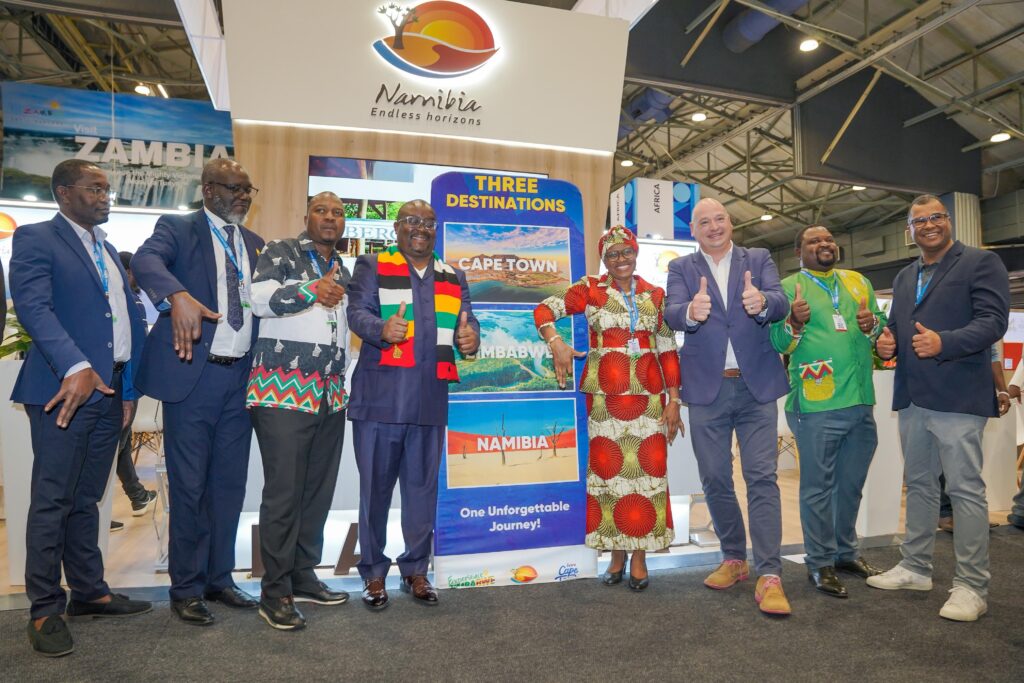
The landscape of Southern African tourism shifted decisively this week at Africa’s Travel Indaba 2026. Following months of strategic anticipation, the formal launch of the joint marketing partnership between Cape Town, Zimbabwe, and Namibia was cemented with a series of high-level ministerial addresses. The message from the podium was unanimous: the era of cross-border competition is over, replaced by a “team sport” approach designed to capture a larger slice of the global travel market.
The partnership – uniting the urban sophistication of the Mother City, the thunderous majesty of Zimbabwe’s Victoria Falls, and the ethereal desert landscapes of Namibia’s Skeleton Coast – seeks to create a seamless “multi-destination” itinerary for long-haul international travellers.
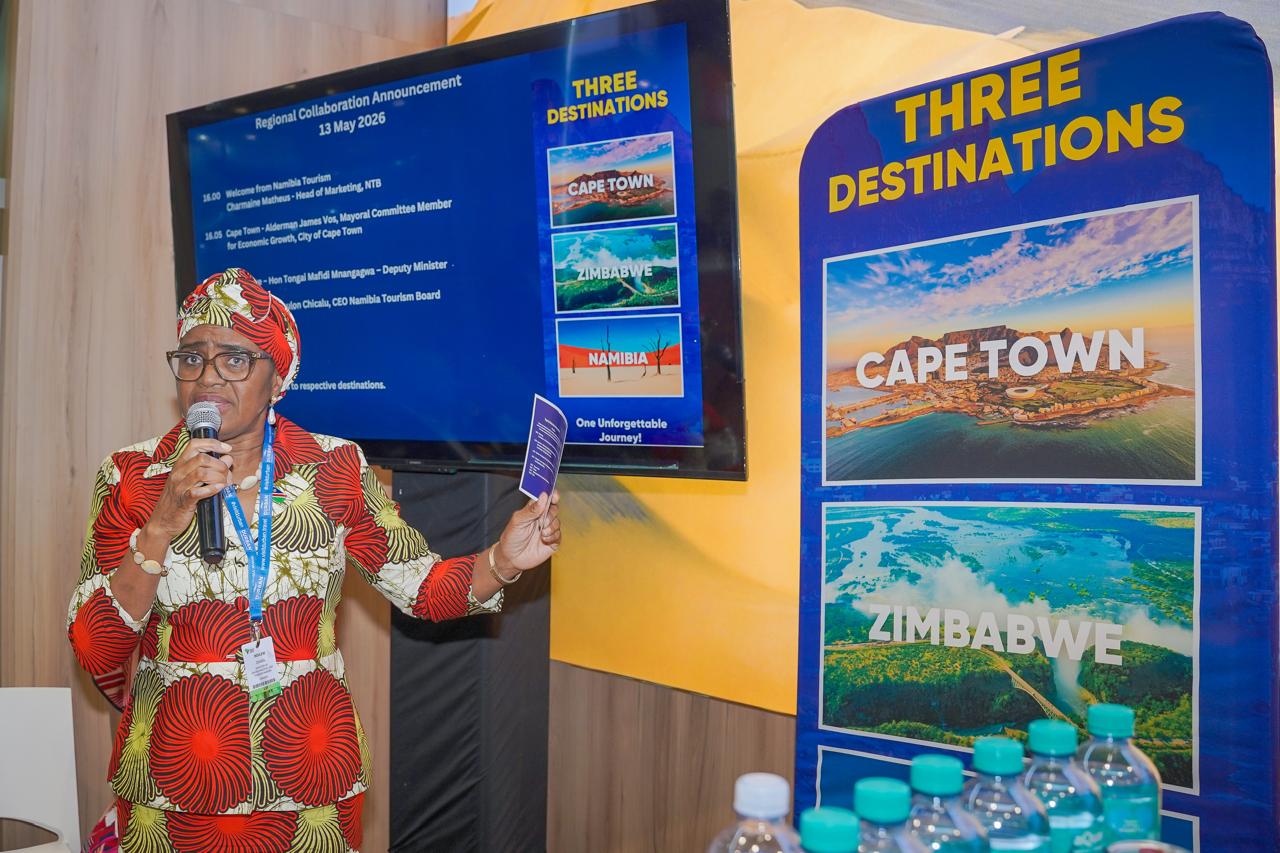
Namibia’s Minister of Environment,Forestry and Tourism Indileni Daniel
Cape Town: Tourism as a ”Team Sport”
Opening the ceremony, Alderman James Vos, Cape Town’s Mayoral Committee Member for Economic Growth and Tourism, delivered a spirited address focused on the “why” behind the alliance. For Vos, the partnership is not merely a marketing exercise but a vital engine for job creation and economic resilience.
“Tourism is a team sport,” Vos declared, addressing the delegates. “When these three iconic destinations come together, the story starts to change. We aren’t just selling a city; we are selling a journey that begins in Cape Town and flows into the incredible landscapes of our neighbours.”
Vos emphasised that the modern traveller no longer wants to choose between a cosmopolitan city and a wilderness safari—they want both. By linking these destinations, the partnership aims to drive “stickiness,” encouraging visitors to stay longer on the continent.
“My job is to ensure we create the best value proposition for travellers. By working with our partners in Zimbabwe and Namibia, we make it easier to visit all three. This is how we protect our communities and our jobs for many generations to come,” Vos added, highlighting the importance of infrastructure and air connectivity in making this vision a reality.
Zimbabwe : Surging Numbers and Connectivity
Representing Zimbabwe, Deputy Tourism Minister Tongai Mafidhi Mnangagwa spoke to the tangible excitement currently gripping the Zimbabwean travel sector. He noted that the country is already seeing a “surge” in interest, making this the opportune moment to formalise regional ties.
“It is exciting to see our numbers surging upward,” Mnangagwa remarked. “There is so much interest in the market, but the key to sustaining this is collaboration. We are looking at 10-day itineraries that allow a visitor to experience the best of what we all have to offer.”
The Deputy Minister was quick to point out that the success of the alliance hinges on the “ease of movement.” He confirmed that Zimbabwe is aggressively upgrading its air connectivity and infrastructure to ensure that a tourist landing in Cape Town can reach the Zimbabwean wilderness with minimal friction. “We are ready,” he concluded. “This collaboration is exactly what the market is asking for.”

Namibia: Breaking Down Borders
The Namibian delegation brought a philosophical depth to the launch, focusing on the removal of artificial barriers. Namibia’s Minister of Environment,Forestry and Tourism Indileni Daniel speaking alongside the CEO) praised the collective effort, noting that tourists do not see borders – they see experiences.
“Our working together makes the results and the reactions so much stronger,” the Minister stated. “Because of our borders, we have often stayed apart, but today we play together. We have so much ‘world’ to show the world. This is the method of establishing our roots as a global powerhouse.”
Sebulon Chicalu, CEO of the Namibia Tourism Board, echoed these sentiments, framing the alliance as a “supplementary” rather than competitive relationship. Chicalu pointed out that by pooling resources, the three entities can better compete for the “global pie” of travellers who might otherwise choose destinations in Asia or South America.
“Everyone becomes a winner in this race,” Chicalu said. “We are taking what we have and supplementing one another. After two or three years of this partnership, we expect the numbers to these places to grow exponentially.”
A Growing ” Ripple Effect”
Perhaps the most telling moment of the launch came during Chicalu’s closing remarks, when he revealed that the alliance was already attracting interest from other Southern African nations.
“I have just received a call,” Chicalu told the laughing crowd. “They said, ‘Where is Angola? We want in.’ Mozambique is next. This is just the start.”
The formal programme concluded with a call for “responsible tourism” to ensure that the influx of new visitors does not degrade the very natural wonders—from the Skeleton Coast to the Victorian waterfalls—that make the region unique.
As the delegates moved to the front for the official signing and photo session, the atmosphere was one of palpable optimism. With a combined marketing strategy, improved air links, and a unified voice, the “Golden Triangle” of Cape Town, Zimbabwe, and Namibia is set to become the new benchmark for African travel in 2026 and beyond.