


The Seychelles tourism sector continues its robust upward trajectory, recording significant growth in international visitor arrivals during the eighth week of 2026. According to the latest data from the National Bureau of Statistics, the island nation welcomed 9,974 visitors during this period, marking a 10.5 percent increase compared to the same week in 2025.
This weekly surge has bolstered the year-to-date performance, which now stands at 58,141 arrivals. This represents a 6.3 percent rise over the 54,682 visitors recorded during the corresponding period last year.
Regional Performance: Europe Maintains Dominance
Europe remains the cornerstone of the Seychelles tourism market, accounting for 7,892 arrivals or 79.1 percent of all visitors in week 08. This performance reflects a 12.5 percent increase compared to the previous year. Year-to-date figures further cement Europe’s lead, with 44,293 arrivals representing an 8.3 percent year-on-year growth.
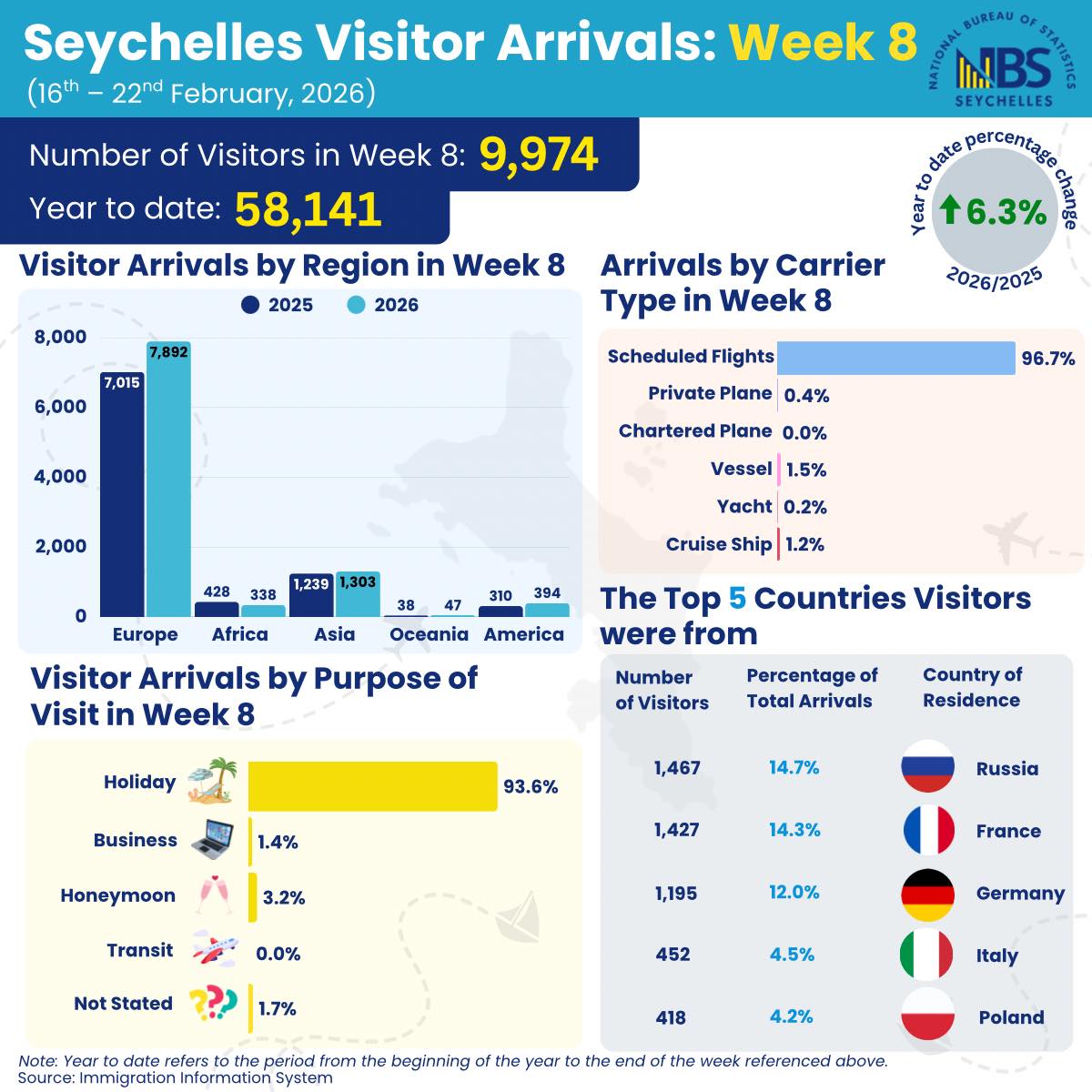
Beyond the dominant European market, other global regions also showed notable weekly gains. The Americas contributed 394 arrivals, reflecting a significant 27.1 percent increase compared to the same week in 2025. Oceania saw 47 arrivals, an uptick of 23.7 percent, while Asia contributed 1,303 visitors, representing a 5.2 percent rise. However, these gains were contrasted by a decline in arrivals from Africa, which dropped by 21 percent for the week and showed a 4.3 percent decrease year-to-date.
A closer country-level analysis reveals a highly competitive landscape among leading source markets, particularly within Europe. Russia emerged as the top contributor for the week with 1,467 arrivals, accounting for 14.7 percent of the total. France followed closely with 1,427 visitors, while Germany contributed 1,195 arrivals. Other significant European contributors included Italy and Poland, which provided 452 and 418 visitors, respectively.

Visitor Profiles and Logistics
The vast majority of travellers visited the archipelago for leisure purposes, with 9,339 visitors (93.6 percent) arriving for holidays. Honeymooners accounted for 323 arrivals (3.2 percent), while business travel represented a modest 1.4 percent of the weekly total with 142 travellers.
In terms of logistics, 96.7 percent of visitors utilised scheduled flights to reach the islands. The data, captured via the Immigration Information System, adheres to World Tourism Organization standards by classifying visitors by their country of residence rather than nationality. Industry stakeholders are looking forward to the next statistical release, scheduled for Wednesday, 4th March 2026, to determine if this momentum carries into the end of the first quarter.