
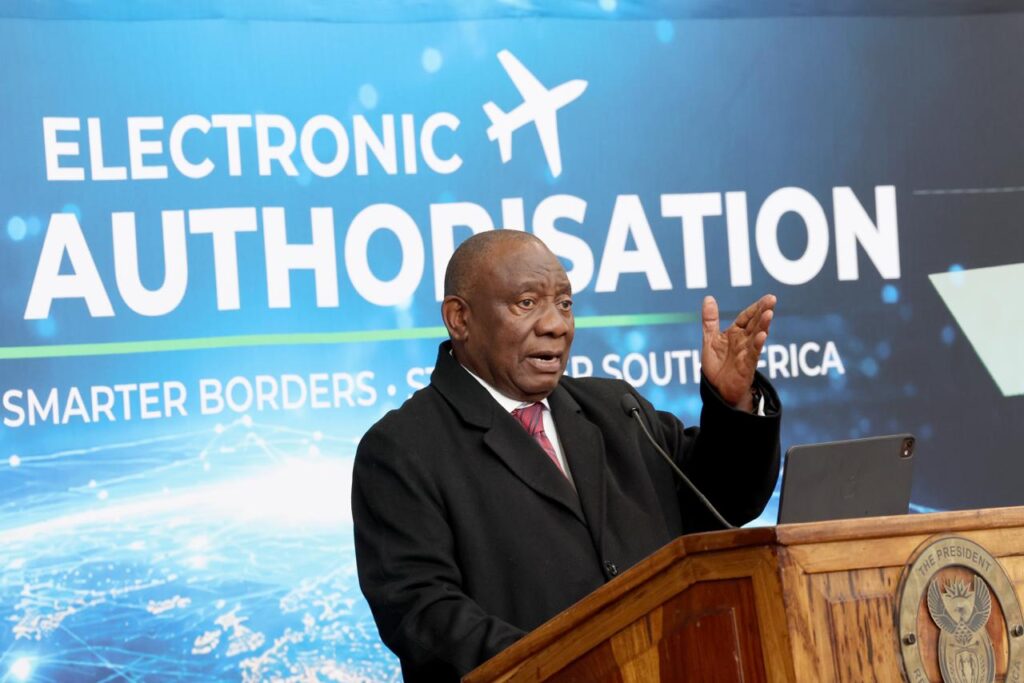
President Cyril Ramaphosa has officially launched South Africa’s Electronic Travel Authorization (ETA) at O.R. Tambo International Airport in Ekurhuleni, Gauteng, marking a major step in the country’s efforts to modernize immigration, strengthen border security and make international travel faster and more seamless.
The ETA, which was piloted during South Africa’s G20 Presidency, combines biometric verification, machine learning and the upgraded Electronic Movement Control System (eMCS 2.0) to create a more integrated digital immigration process.
Speaking at the launch, President Ramaphosa said the way a country welcomes its visitors shapes how it is remembered, with the first impression beginning long before a traveller reaches a hotel, conference centre or game reserve.
“It begins at the border gate as they enter the country,” he said, stressing that South Africa must project itself as a country that is welcoming, efficient and secure.
Ramaphosa said the transformation was about more than introducing a new digital platform. It was also about how South Africa positions itself in an increasingly competitive global environment.
“In today’s world, countries compete not only through the strength of their economies or the quality of their infrastructure. They compete through the ease with which people can visit the country,” he said.
The President linked easier travel with the ability to attract tourists, investors, business travellers, students and people seeking opportunities to trade and exchange skills and knowledge.
The ETA allows eligible travellers to apply online without having to visit a South African mission or visa processing centre. The system uses digital processing, biometric verification and machine-learning capabilities to assess applications and strengthen identity and risk verification.
At the border, biometric and facial-recognition technology can help confirm that the person arriving is the same traveller whose authorisation was approved, while the upgraded electronic movement-control system supports processing at the point of entry.
The system is designed to allow South African authorities to know more about travellers before they arrive, strengthening the country’s ability to identify fraudulent documents, manage immigration risks and protect the integrity of its borders.
At the same time, the digital process is intended to make legitimate travel faster and more predictable.
The initial rollout focused on eligible travellers from China, India, Indonesia and Mexico, following the system’s pilot during South Africa’s G20 Presidency. More than 200,000 applications have since been processed, with the technology also identifying thousands of fraudulent applications.
Government has set a target of processing eligible tourist applications within 24 hours, representing a significant shift from traditional visa processes that have often required physical documentation and visits to visa centres.
For South Africa’s tourism industry, the reform is particularly significant as the country seeks to strengthen access from key international markets and improve its competitiveness as a destination.
Ramaphosa said the impact of the reform should extend beyond tourism, noting that easier access can support investment, trade, business, study and the exchange of skills and knowledge.
He also connected the reform directly to employment, pointing to the wider economic activity generated when more people travel.
“More visitors mean more hotel bookings, more restaurants filled, more tour operators employed, more flights, more conferences, more exports, more investment and more opportunities for South Africans to earn an income and build a better future,” he said.
The ETA is expected to expand beyond its initial markets, with government working towards extending the digital system to additional visa-required countries. Over time, the broader digital immigration programme is also expected to accommodate other categories, including work and study-related immigration services.
For Ramaphosa, the launch represents another step in positioning South Africa as a country that can combine openness with effective border management.
He said the country should not have to choose between making travel easier and maintaining strong immigration controls.
“Technology allows us to know more about travellers before they arrive rather than after they enter,” he said, adding that a modern immigration system should strengthen both economic openness and national security.
The live demonstration at O.R. Tambo gave the President an opportunity to see the system in operation as a passenger was processed through the new digital journey.
Reflecting on the experience, Ramaphosa said he saw “joy and pleasure” on the face of the first passenger involved in the demonstration.
For South Africa, the ETA represents a shift towards a more digital approach to welcoming international travellers while maintaining stronger tools for border management.
“Today, we are taking another important step in ensuring that South Africa competes with the best in the world,” Ramaphosa said.