
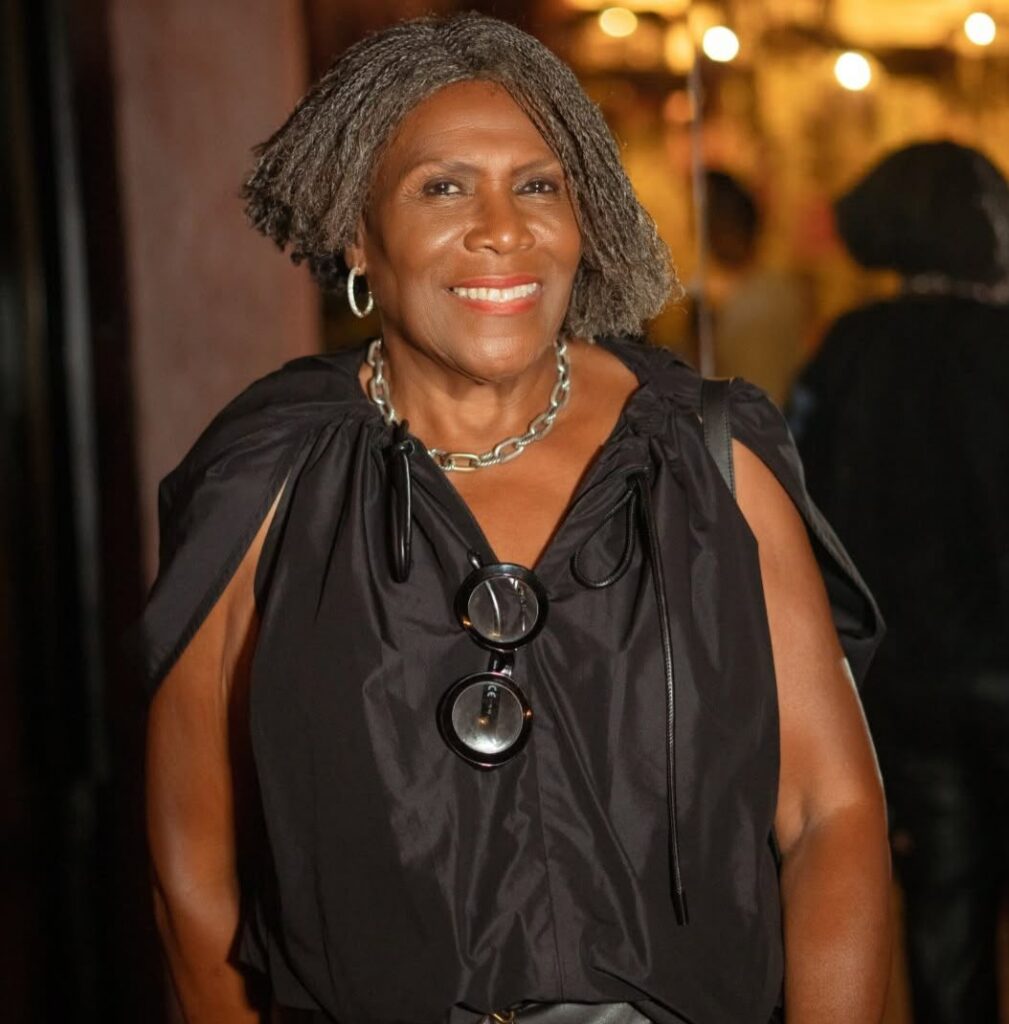
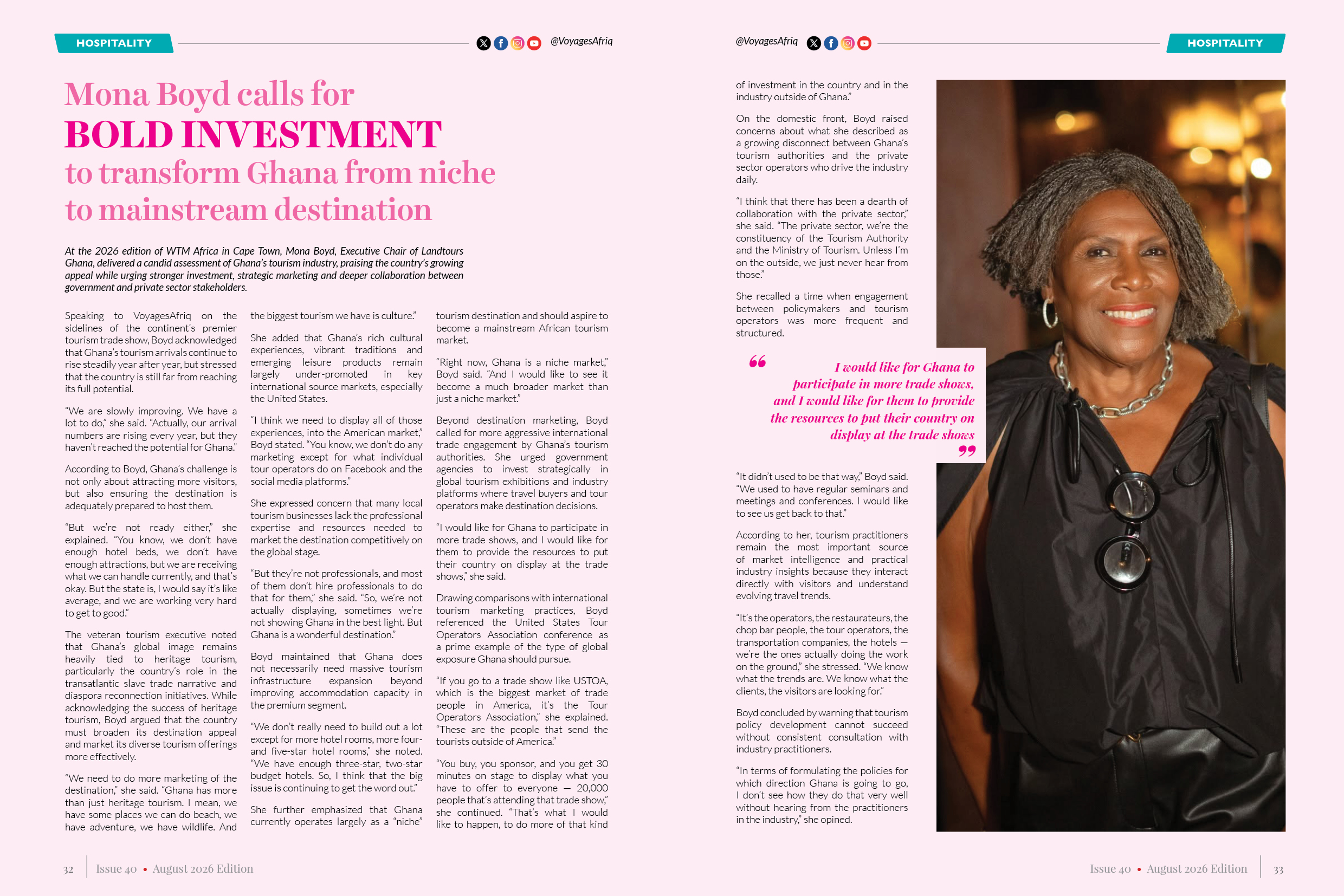
At the 2026 edition of WTM Africa in Cape Town, Mona Boyd, Executive Chair of Landtours Ghana, delivered a candid assessment of Ghana’s tourism industry, praising the country’s growing appeal while urging stronger investment, strategic marketing and deeper collaboration between government and private sector stakeholders.
Speaking to VoyagesAfriq on the sidelines of the continent’s premier tourism trade show, Boyd acknowledged that Ghana’s tourism arrivals continue to rise steadily year after year, but stressed that the country is still far from reaching its full potential.
“We are slowly improving. We have a lot to do,” she said. “Actually, our arrival numbers are rising every year, but they haven’t reached the potential for Ghana.”
According to Boyd, Ghana’s challenge is not only about attracting more visitors, but also ensuring the destination is adequately prepared to host them.
“But we’re not ready either,” she explained. “You know, we don’t have enough hotel beds, we don’t have enough attractions, but we are receiving what we can handle currently, and that’s okay. But the state is, I would say it’s like average, and we are working very hard to get to good.”
The veteran tourism executive noted that Ghana’s global image remains heavily tied to heritage tourism, particularly the country’s role in the transatlantic slave trade narrative and diaspora reconnection initiatives. While acknowledging the success of heritage tourism, Boyd argued that the country must broaden its destination appeal and market its diverse tourism offerings more effectively.
“We need to do more marketing of the destination,” she said. “Ghana has more than just heritage tourism. I mean, we have some places we can do beach, we have adventure, we have wildlife. And the biggest tourism we have is culture.”
She added that Ghana’s rich cultural experiences, vibrant traditions and emerging leisure products remain largely under-promoted in key international source markets, especially the United States.
“I think we need to display all of those experiences, into the American market,” Boyd stated. “You know, we don’t do any marketing except for what individual tour operators do on Facebook and the social media platforms.”
She expressed concern that many local tourism businesses lack the professional expertise and resources needed to market the destination competitively on the global stage.
“But they’re not professionals, and most of them don’t hire professionals to do that for them,” she said. “So, we’re not actually displaying, sometimes we’re not showing Ghana in the best light. But Ghana is a wonderful destination.”
Boyd maintained that Ghana does not necessarily need massive tourism infrastructure expansion beyond improving accommodation capacity in the premium segment.
“We don’t really need to build out a lot except for more hotel rooms, more four- and five-star hotel rooms,” she noted. “We have enough three-star, two-star budget hotels. So, I think that the big issue is continuing to get the word out.”
She further emphasized that Ghana currently operates largely as a “niche” tourism destination and should aspire to become a mainstream African tourism market.
“Right now, Ghana is a niche market,” Boyd said. “And I would like to see it become a much broader market than just a niche market.”
Beyond destination marketing, Boyd called for more aggressive international trade engagement by Ghana’s tourism authorities. She urged government agencies to invest strategically in global tourism exhibitions and industry platforms where travel buyers and tour operators make destination decisions.
“I would like for Ghana to participate in more trade shows, and I would like for them to provide the resources to put their country on display at the trade shows,” she said.
Drawing comparisons with international tourism marketing practices, Boyd referenced the United States Tour Operators Association conference as a prime example of the type of global exposure Ghana should pursue.
“If you go to a trade show like USTOA, which is the biggest market of trade people in America, it’s the Tour Operators Association,” she explained. “These are the people that send the tourists outside of America.”
“You buy, you sponsor, and you get 30 minutes on stage to display what you have to offer to everyone — 20,000 people that’s attending that trade show,” she continued. “That’s what I would like to happen, to do more of that kind of investment in the country and in the industry outside of Ghana.”
On the domestic front, Boyd raised concerns about what she described as a growing disconnect between Ghana’s tourism authorities and the private sector operators who drive the industry daily.
“I think that there has been a dearth of collaboration with the private sector,” she said. “The private sector, we’re the constituency of the Tourism Authority and the Ministry of Tourism. Unless I’m on the outside, we just never hear from those.”
She recalled a time when engagement between policymakers and tourism operators was more frequent and structured.
“It didn’t used to be that way,” Boyd said. “We used to have regular seminars and meetings and conferences. I would like to see us get back to that.”
According to her, tourism practitioners remain the most important source of market intelligence and practical industry insights because they interact directly with visitors and understand evolving travel trends.
“It’s the operators, the restaurateurs, the chop bar people, the tour operators, the transportation companies, the hotels — we’re the ones actually doing the work on the ground,” she stressed. “We know what the trends are. We know what the clients, the visitors are looking for.”
Boyd concluded by warning that tourism policy development cannot succeed without consistent consultation with industry practitioners.
“In terms of formulating the policies for which direction Ghana is going to go, I don’t see how they do that very well without hearing from the practitioners in the industry,” she opined.
This article was first published in the August 2026 Edition of VoyagesAfriq TraveL Magazine