

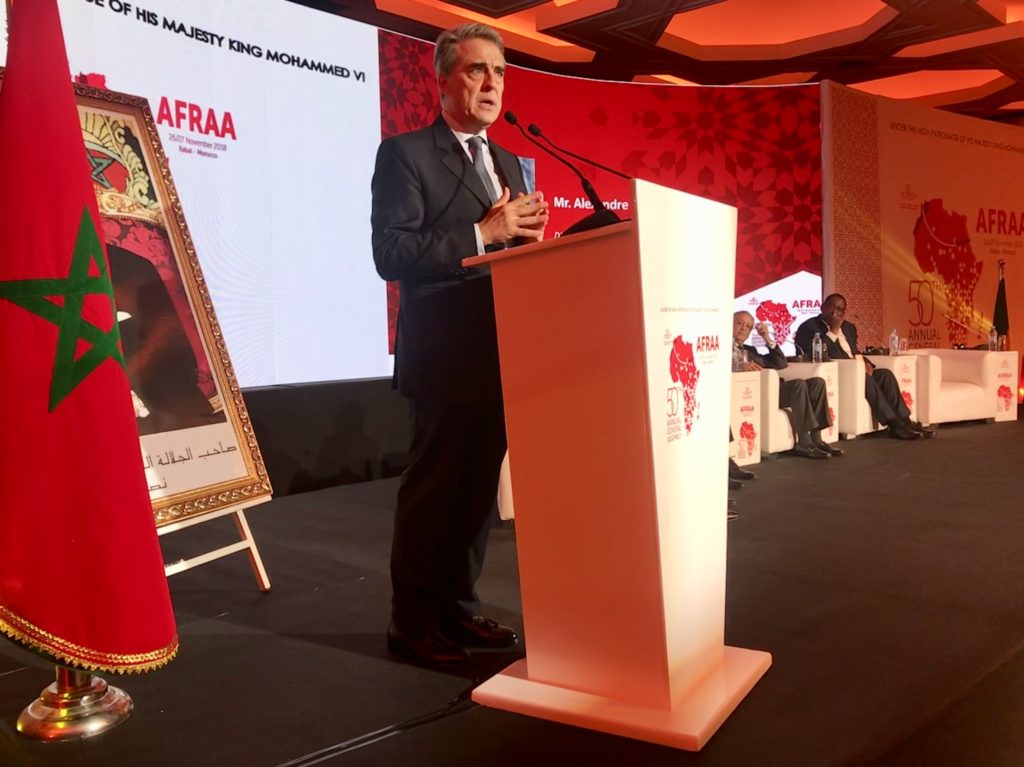
There is the need for African governments to work to remove taxes that beset the operations of airlines on the continent to ensure their competitiveness. This is according to Alexandre de Juniac, Director General and CEO, International Air Transport Association (IATA) who believes that the potential aviation wields in building the economic future of Africa can be realized if airlines were not overburdened with taxes that negatively affect their profit margins. Juniac made this observation when he addressed delegates at the 50th Annual General Assembly (AGA) meeting of the African Airline Association (AFRAA) in Morocco earlier this week.
He said the global average profit per passenger is $7.80. But airlines in Africa, on average, lose $1.55 for every passenger carried. This disparity has many causes. To begin with, Africa is an expensive place for airlines to do business. Jet fuel costs are 35% higher than the rest of the world. User charges reflect 11.4% of airlines operating cost in Africa – four times that of North America and double industry average. And taxes and fees are among the highest in the world.

“There is no shortage of examples illustrating the heavy burden that governments extract from aviation: In Niger $80 from each ticket is paid to the government in fees, taxes and charges, Cameroon recently added a $37 development tax per passenger, DR Congo charges every arriving passenger $15 to promote tourism—rather counter-productive if you think of it, and Ethiopia’s $24 departure tax undermines the hub’s competitiveness,” Juniac remarked.
He further opined that contrary to the perception by many governments that aviation is a luxurious means of transport, it has become a necessary means to ensuring connectivity; hence any tax regime that seems to undermine and stifle the industry’s growth should be done away with. While some African governments were taking steps to scrap nuisance taxes on airline operations, the IATA boss believes more ought to be done.
“There is some good news however. In May, Equatorial Guinea removed its 15% VAT on tickets. Still, too many African governments view aviation as a luxury rather than a necessity. We must change that perception. The value of aviation for governments is not in the tax receipts that can be squeezed from it. It is in the economic growth and job creation that aviation supports.”
For Juniac, the need to improve competitiveness is one of the factors that will enable aviation to be an even bigger driver of prosperity across the continent. “Already aviation is a considerable force, supporting $55.8 billion of economic activity and 6.2 million jobs in Africa. That’s impressive. But we are only scratching the surface of what aviation can contribute to building Africa’s future,’’ he added.
Story by: Samuel Obeng Appah