
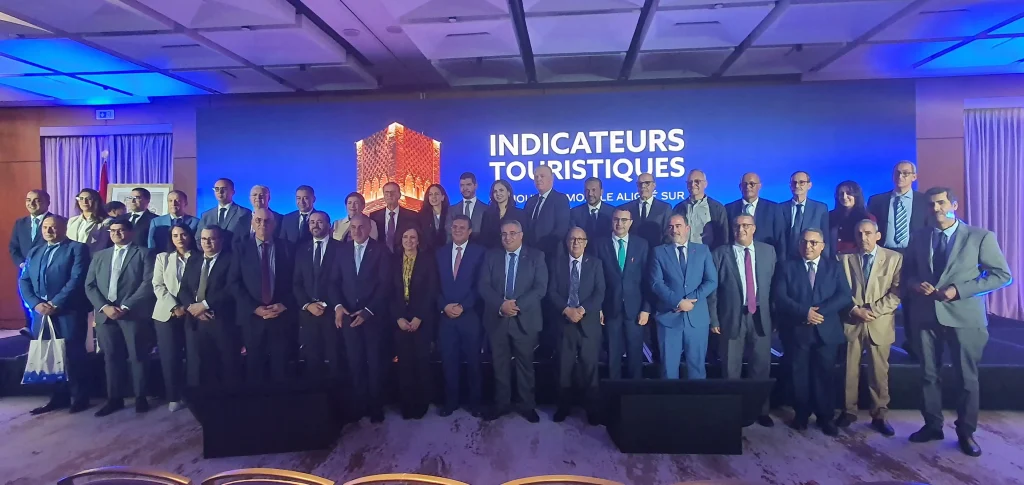
Morocco has announced a major overhaul of its tourism statistics model, a move officials say will bring the country’s data systems in line with international standards and strengthen evidence-based decision-making across the sector. The announcement was co-chaired by Minister of Tourism, Handicrafts, and the Social and Solidarity Economy, Ms. Fatim-Zahra Ammor, and President of the National Tourism Confederation (CNT), Mr. Hamid Bentahar.
The upgrade forms part of the country’s 2023–2026 Tourism Roadmap and is designed to deliver comprehensive, reliable, and directly actionable data for professionals, policymakers, and investors. The model uses a representative sample that reflects accommodation categories, destination characteristics, and seasonality, and further validates estimates through field data. Officials say this approach will produce more accurate measurements of sector activity, stronger indicators, and clearer insights into visitor numbers at high-value, low-cost and high-value (HVL) establishments.
UN Tourism expert Mr. Michel Julian, who presented global best practices and the regulatory framework underpinning the new model, attended the announcement—an indication of the organisation’s strong backing for Morocco’s reforms.
Highlighting the need for robust, decision-friendly data tools, Ms. Ammor noted: “The tourism sector in Morocco is undergoing significant development. To support this growth, it is essential to have decision-making tools to guide the sector and advise both professionals and investors. We have therefore developed a new model in collaboration with UN Tourism, in line with international best practices.”
Speaking on behalf of the private sector, Mr. Bentahar emphasised the model’s role in strengthening competitiveness and sector-wide knowledge: “This new dashboard model allows us to meet international standards and offer all professionals, investors, and data users an interactive tool—one that simplifies the understanding of the various indicators. Data is an exceptional opportunity to make informed decisions, develop skills, and contribute to sustainable development.”
UN Tourism’s Mr. Julian also underscored the significance of the initiative, stating: “For his part,” said Michel Julian, an expert with UN Tourism, “it is a pleasure, as a representative of UN Tourism, the United Nations specialized agency for tourism, to support Morocco and the tourism authorities of this wonderful country today in launching a new project aimed at improving the measurement of tourist arrivals. This will have a direct impact on the country’s competitiveness and, of course, on the performance of the destination.”
To give practical effect to the revamped statistics model, the Tourism Observatory has introduced a new website featuring an interactive dashboard developed with support from UN Tourism and the European Bank for Reconstruction and Development (EBRD). The platform provides seamless, intuitive access to up-to-date indicators, along with comparison and analysis tools tailored for all actors in the tourism ecosystem.
The overarching aim, officials say, is to transform high-quality data into a long-term competitive advantage—driving innovation, strengthening business performance, and supporting sustainable growth across Morocco’s destinations.