
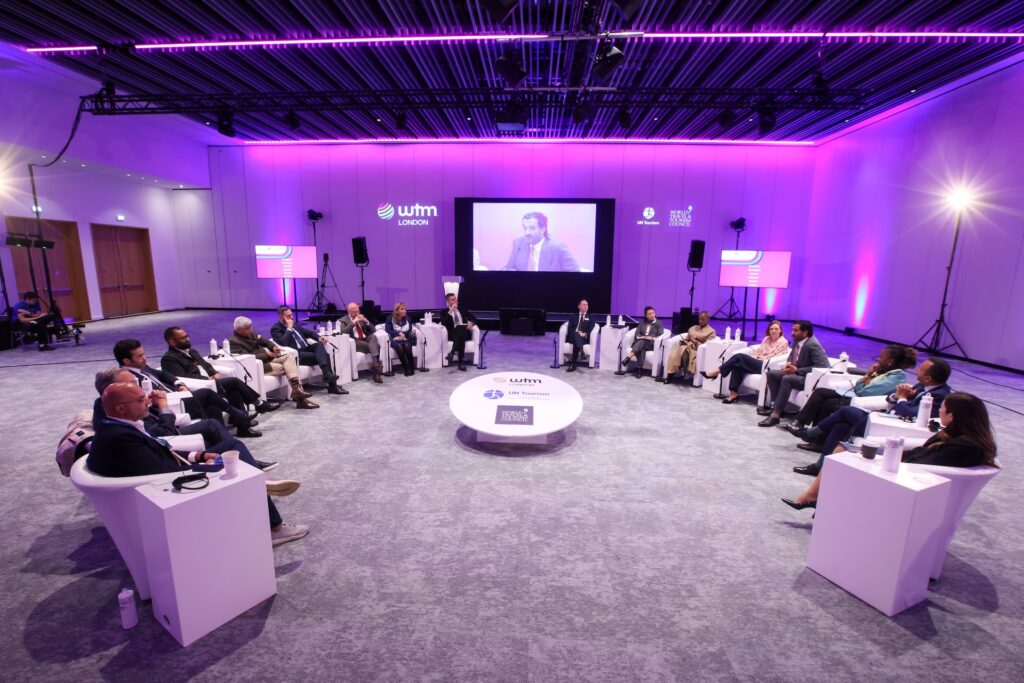
Listening and liaising with customers, communities and industry partners was a key theme debated across the stages during the second day of WTM London, part of RX Global.
Speakers on the accessibility panel on the Wanderlust Stage urged the travel industry to listen more and give disabled travellers better information to help them make travel decisions.
“Disabled people are all different; historically the industry has been asking the wrong questions,” said Dr Gregory Burke, Founder and Group Chief Executive at AccessAble. “You should be asking what someone needs to know, to decide if a hotel works for them.”
He noted the ‘purple pound’ is worth $446 billion a year in the UK but said the “greater argument” is about society: “People should be treated with dignity. Our vision is for a much more inclusive model.”
The debate built on the new report from Spain for All about hotels’ accessibility information, and Jesús Ruiz, Head of Sustainability, Accessibility and Impact at the Spanish Tourist Office in the UK, said every traveller could potentially become a disabled traveller – especially as we age.
Sassy Wyatt, CEO of Blind Girl Adventures, told delegates that 95% of website home pages have accessibility errors. “As a blind woman with a guide dog, my money is the same as yours. If I’m refused access, you’re not getting my money,” she said – noting she also visits with friends and family, who represent another income stream.
Wheelchair user Harry Wales, a travel agent with Travelosophers and founding member of the Spain for All Advisory Board, said he feels “fear” approaching a hotel room door in case it has not got the facilities that he has requested.
Moderator Sophie Morgan – broadcaster, author and travel writer – had faced that scenario the night before in a pricey hotel but, despite checking in advance, the shower seat was not appropriate, meaning she couldn’t have a shower. “It happens more often than you think; I can’t tell you the anxiety,” she told the audience.
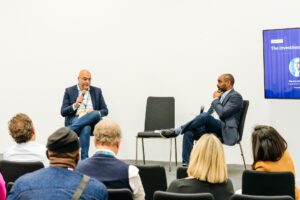
Listening to local communities was a key theme in the Trends Stage session about creating destinations “with real identity”.
Todd Babiak, CEO at Brand Gold Coast, explained how telling the stories of ‘Gold Coasters’ can overcome “mushy 1980s” misperceptions of the Australian destination and Danny Cohanpour, CEO at Trove Tourism Development Advisors, spoke about the importance of speaking to locals, which helped develop grass-roots campaigns such as ‘Yard Love’ in Jamaica and Kam, Yumi Raun! (Come Explore With Us!) in Papua New Guinea.
Merette Elsayed, Chief Executive Officer of Legacy Development and Management, the company responsible for managing the Grand Egyptian Museum, highlighted the importance of working with Egyptians as the attraction was built, including showcasing handicrafts in the museum shop.
Nicola Gryczka Kirsch, Co-founder and Chief Weaving Officer of Regenopolis, talked about the Ibiti Project in Brazil, which has restored biodiversity and developed hospitality concepts with locals, while Emma Campbell, CMO, Ras Al Khaimah Tourism Development Authority, said the emirate has many stories to tell, thanks to its 7,000 years of history and role as an ancient trading port – as well as mountains, deserts and maritime communities, “things that can’t be manufactured”.
Listening to travellers and locals was explored by John Speers, VP Tourism Strategy at TruReach, who helps destinations, hoteliers and experience providers to design journeys with “emotional depth”. “When you get emotion right, you get economic value. Emotion drives business,” he said in his session.
“Transformative experiences are starting to become a reality; people don’t just get on a plane, they go to feel something…and to be transformed”. He worked with the Saudi Tourism Authority to attract Chinese tourists, whittling down 300 experiences to two “quintessential” options to promote – a desert campfire experience and a Land Rover excursion.
“They are about emotion and fun – and they drove three times more visitation from China to Saudi,” he said, noting he also visited China to speak to Chinese consumers. “Passion and emotion equal economic value.”
At the Experience Hub, a session entitled ‘Stop Segmenting. Start Listening’ advised destinations and travel businesses to use ‘social listening’ for product development and marketing. Social listening means combining insights from reviews and in-person feedback with wider social media chat from a target demographic.
Speaker Catherine Warrilow, founder of The Plot – a consultancy which helps UK attractions boost their income – uses AI to help aggregate such data.
She told businesses they could “layer this information together to find the gap between [what your customers are saying] and the language you use in your marketing”.
Looking at what target audiences say about a business and their wider lives could also “help identify triggers to book activities or holidays”. Warrilow said social media insights about Manchester families’ free time helped a museum build an events programme.
AI can also spot opportunities with upcoming anniversaries, events and film releases. “If you only do one thing, export your 50 most recent reviews and ask AI to look for common themes; you can then use these in your marketing,” she advised.
Technology and AI were also explored on the Future Stage, in a discussion about who should own the traveller journey – brands, platforms or agents. Merilee Karr, founder and CEO of short-term rental company UnderTheDoormat Group said building brand loyalty was the most important consideration.
This was echoed by Amit Shamni, Co-Founder and CEO of Bridgify (part of HBX Group), who said, whether the ‘owner’ was a hotel or airline, “the trust is where the brand stays [because] AI is only the facilitator of intelligence”.
But Karr also predicted larger companies could drop online travel agencies (OTAs): “Distribution is going to crash…I think those brands who own the supply have a lot of power for the [AI] agents to discover them…however, amateurs and small brands who don’t have the big enough presence to do that on their own may rely still on OTAs to do that for them.”
She said AI had helped her company improve back-office efficiency. For instance, with late check-outs, it previously could take nine manual steps to work out if the request was feasible.
The Future Stage also hosted a discussion highlighting different approaches to AI between Europe and China. Crystal Pang, from China’s premier social search, e-commerce and travel-planning platform RedNote, said the app now reaches more than 400 million users and handles more than one billion searches a day.
She was joined by Leon Li, Vice President of Public Affairs for Fliggy, the Chinese OTA which has 1.3 billion users and is part of the Alibaba Group’s AI-focused ecosystem.
He noted a big difference between China and Europe where “travel search is now done through conversation” and told destinations: “You need to understand how to tell your story, because if you don’t, someone else will.” Atout France, represented by Adam Oubuih, works with Fliggy and is aware of the importance of being discovered in this way in this market.
He outlined a dilemma facing France: “We have a diverse tourism product and this fragmentation is one of our strengths. But this leads to a fragmentation of data, which can be a weakness.” His approach to AI is that it can help to “keep the diversity and engineer out the friction”.
The Future Stage audience also heard about the travel industry’s “growth paradox” and whether the sector can ever be responsible or sustainable when the economics and incentives remain focused on volume.
Erika Harms, who oversees sustainability for Iberostar, talked about the importance that the fourth-generation, family-owned chain places on its legacy. She outlined its commitments to a range of initiatives but was clear that “we need to perform as a business so that we are in business to bring the economic benefits to the communities”.
“Economic impacts on communities” is the key metric for Much Better Adventures, whose CEO Alex Narracott talked about its model which analyses not only how much tourism income stays “in the destination” but also how it is then “distributed within the community”.
Another approach to the growth paradox is for a destination to be comfortable with not increasing visitor numbers. Juana Ortiz Basso from Los Cabos Tourism said it was “rebuilding the product” so that Los Cabos is seen as a destination with beaches rather than a beach destination, because this expands where and with whom visitors spend.
Elsewhere, luxury travel and fine dining were in the spotlight with Mexico’s VidantaWorld. Iván Chávez, executive VP at Grupo Vidanta, said a new feature called BON – Beauty of Nature – is the “world’s first all-generation luxury theme park”.
“The kids can be out on the rides while the parents and grandparents can enjoy quality restaurants,” he said. The $1.5 billion park soft-opened last month ahead of public opening next year.
Chavez also enthused about ELEGANT, its 81 all-suite Mediterranean cruise ship, which he compared to a luxury megayacht experience. He said the itinerary includes many overnight stays, allowing guests to explore ports at leisure without having to return for a 4pm departure.
VidantaWorld has a strong relationship with Cirque du Soleil, hosting the entertainment group’s only two permanent residencies outside the US.