

“The only two certainties in life are death and taxes,” the old adage goes. Thankfully, steady safety improvements mean the former is far less likely in African aviation than it once was.But to make up for that, the one certainty that seems determined to climb ever higher is taxation – direct and indirect – on anyone who dares to fly within Africa.
Across the continent, policymakers still behave as if air travel is a luxury for the elite thatshould be priced and taxed accordingly. The result is a tidy, self-fulfilling prophecy: treat aviation as a playground for the privileged, and you guarantee it remains just that. When taxes and fees swell the final ticket price beyond the reach of ordinary travellers, demand shrinks into the subset of those who can absorb the pain. Smaller market, thinner schedules, higher unit costs – lather, rinse, repeat.
Crucially, the “tax” that strangles demand isn’t a single line item. It’s a stack: passenger taxes and levies, airport and air navigation service charges, security and health surcharges, visa and insurance fees. Then there are the quasi-taxes – opaque border controls, duplicative inspections, and compliance schemes priced far above the cost to deliver them. Each layer may look modest in isolation but together they build a wall that many would-be passengers choose to never climb.
Consider Tanzania. In 2024, visitors to Zanzibar were hit with a mandatory health insurance fee. Despite the modest extra charge, tourist numbers still grew – a testament to Zanzibar’s strong pull and pent-up demand. Emboldened, a similar scheme is now being expanded to the mainland of Tanzania. On top of that, a new airport tax is being introduced for international travellers, ostensibly to fund a digital border control system, but priced well above the apparent cost of the system itself. By 2026, every visitor will be paying roughly $200 more than they were in 2024. Is tourism demand for Tanzania so inelastic that it can absorb increase after increase indefinitely? Time will tell, but history usually turns out to be less forgiving than budget projections.
Kenya too is reviewing airport taxes upward. Nigeria has signalled increases to fund an Advance Passenger Information (APIS) system. Let’s be clear – funding modern systems and better infrastructure is not optional. The question is whether we can calibrate the price of progress without pricing out the very travellers and airlines who are supposed to benefit. Push too far and you end up taxing the promise out of the project.
Sierra Leone is a cautionary tale hiding in plain sight. Freetown today boasts a gleaming new terminal, a new national airline, and an industry unrecognisable from the dark days of conflicttwo decades ago. Yet the market remains stifled by high charges and user fees. Fly the 40-minute hop from Freetown to Monrovia and back: you will pay around $450 in taxes and fees on top of the ticket itself. For airlines, the stack at Freetown – landing fees, ground handling, fuel and so forth – can be double or triple those at other airports in the region. Regulators defend the regime as the cost of recouping private investment in infrastructure, but the end result is an airport that is underserved and underutilised. Build it and they will come – unless you charge so much at the gate that they turn back and go home instead.
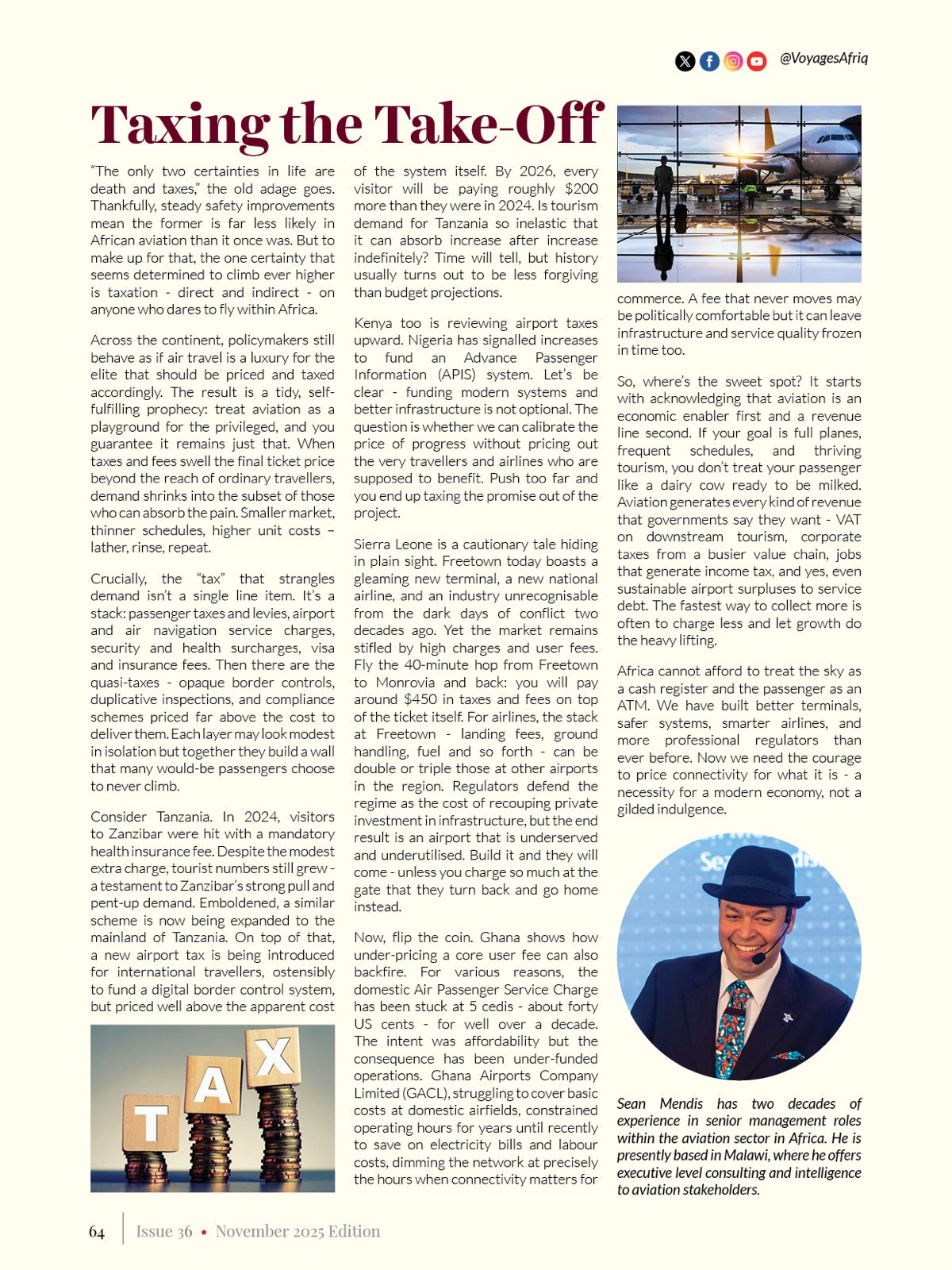
Now, flip the coin. Ghana shows how under-pricing a core user fee can also backfire. For various reasons, the domestic Air Passenger Service Charge has been stuck at 5 cedis – about forty US cents – for well over a decade. The intent was affordability but the consequence has been under-funded operations. Ghana Airports Company Limited (GACL), struggling to cover basic costs at domestic airfields, constrained operating hours for years until recently to save on electricity bills and labour costs, dimming the network at precisely the hours when connectivity matters for commerce. A fee that never moves may be politically comfortablebut it can leave infrastructure and service quality frozen in time too.
So, where’s the sweet spot? It starts with acknowledging that aviation is an economic enabler first and a revenue line second. If your goal is full planes, frequent schedules, and thriving tourism, you don’t treat your passenger like a dairy cow ready to be milked. Aviation generates every kind of revenue that governments say they want – VAT on downstream tourism, corporate taxes from a busier value chain, jobs that generate income tax, and yes,even sustainable airport surpluses to service debt. The fastest way to collect more is often to charge less and let growth do the heavy lifting.
Africa cannot afford to treat the sky as a cash register and the passenger as an ATM. We have built better terminals, safer systems, smarter airlines, and more professional regulators than ever before. Now we need the courage to price connectivity for what it is – a necessity for a modern economy, not a gilded indulgence.
Sean Mendis has two decades of experience in senior management roles within the aviation sector in Africa. He is
presently based in Malawi, where he offers executive level consulting and intelligence to aviation stakeholders.
This Article was first published in the Issue 036 of VoyagesAfriq Travel Magazine