
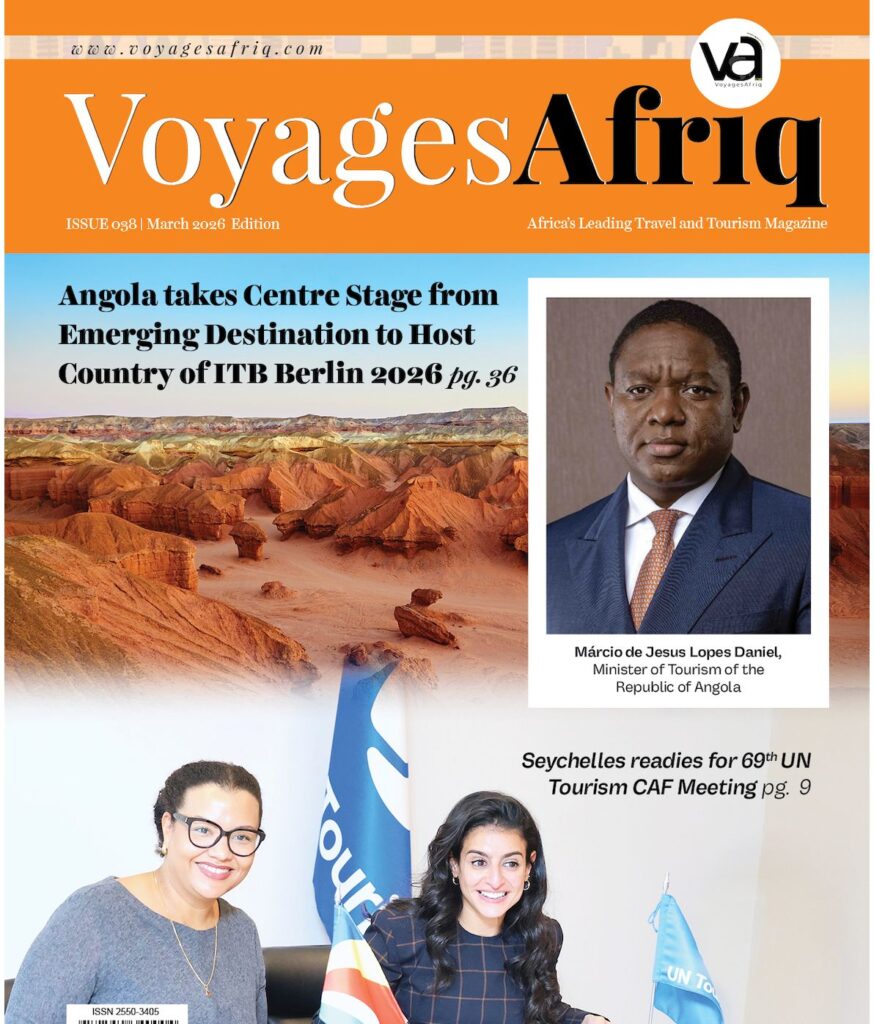
Africa’s leading travel and tourism magazine, VoyagesAfriq, has officially released its March 2026 edition, delivering a sweeping overview of the continent’s accelerating tourism transformation and rising global influence.
Headlined by Angola’s historic designation as Host Country of ITB Berlin, the new edition captures what it describes as a defining period for African tourism—one marked by stronger policy coordination, aviation expansion, strategic investment and growing international visibility.
At the heart of the issue is Angola’s emergence from an “emerging destination” to a global tourism host nation, positioning the Central African country before international buyers and decision-makers at one of the world’s most influential travel trade shows. The development is framed not only as a national milestone but as a continental win, reinforcing Africa’s growing competitiveness in the global tourism economy.
The edition also provides extensive coverage of UN Tourism and its newly launched roadmap towards the International Year of Sustainable and Resilient Tourism 2027. With sustainability now shifting from dialogue to structured implementation, the magazine examines how African destinations are aligning with global frameworks while asserting stronger leadership within multilateral tourism platforms.

Among key highlights, Seychelles prepares to host the 69th UN Tourism Regional Commission for Africa meeting, while Zimbabwe secures hosting rights for a landmark 2027 sustainability planning meeting. Malawi’s cabinet reshuffle, which sees seasoned corporate executive Simon Itaye take charge of tourism, signals a growing recognition of private-sector expertise in national tourism management.
Details of Cameroon’s readiness host the industry for its 2026 International Tourism Fair and several stories from this year’s FITUR are highlighted in the new edition.
The March edition further explores Zanzibar’s tourism boom, where record-breaking arrivals are unlocking investment opportunities beyond accommodation into experiential infrastructure, aviation expansion and marine transport.
Aviation’s structural role in Africa’s tourism growth is also examined ahead of AviaDev Africa, scheduled to take place in Gaborone, Botswana, in June 2026.
In a significant mobility milestone, Zambia and Ghana announce a historic visa-free travel agreement aimed at deepening regional integration and stimulating tourism and trade flows.
Beyond destination developments, the magazine presents insights from Skift’s 2026 Megatrends report, first launched on African soil in Cape Town, outlining how rising middle-class demand, luxury travel expansion, AI-driven discovery platforms and long-term capital investment are reshaping competitiveness across the continent.
Editorially led by Managing Editor Kojo Bentum-Williams and a pan-African team of contributors, the publication reaffirms its commitment to contextual, policy-aware reporting that connects governments, investors, airlines, tourism boards and hospitality leaders.
The lastest publication is also replete with opinion pieces from some of the industry’s finest minds on various subjects.
There is a compilation of events and trade shows and travel and tourism blitz for readers who want to stay to informed about happenings in the industry.
As Africa navigates a period defined less by ambition and more by execution, the March 2026 Edition of VoyagesAfriq positions itself as both chronicler and convener of the continent’s tourism evolution and is a highly recommended read.