
The Travel, Hospitality and Tourism Education Summit 2026 convened a high level Ministerial Roundtable at the Mulungushi International Conference Centre in Lusaka on 14th April 2026, bringing together government ministries, education authorities, and industry stakeholders to advance a coordinated approach to tourism human capital development.
Convened by the Zambia Institute for Tourism and Hospitality Studies (ZITHS), the summit focused on aligning education systems, labour frameworks, and industry needs under a shared governance model aimed at strengthening productivity, skills development, and economic transformation.
Ministerial deliberations strongly iterated government’s commitment to an integrated governance approach across tourism, labour, commerce, and education sectors.
Minister of Labour and Social Security, Brenda Tambatamba, located coordination efforts within the Skills Advisory Committee under her ministry, describing it as the central mechanism for aligning labour market needs with training systems.
She said, “The coordination that has been spoken about is anchored in the Ministry of Labour and Social Security through the Skills Advisory Committee that brings various stakeholders, ensuring employment and employability are given due attention.”
She stressed the urgency of addressing skills mismatches and strengthening the link between training institutions and labour market demand, noting that productivity remains a core driver of economic transformation.
Minister of Commerce, Trade and Industry, Chipoka Mulenga, reaffirmed tourism as a strategic investment sector requiring regulatory simplification and improved ease of doing business.
He stated, “Tourism is key to bringing investment opportunities into our country. There is no way we can separate it from national development priorities.”
He revealed that government is advancing reforms to reduce multiple licensing requirements in the tourism sector, with plans to consolidate approvals under a streamlined regulatory system.
He noted, “We are working to ensure that someone operating a hotel or facility does not require 10 to 20 licenses. This process is being streamlined.”
He added that multiple institutions, including labour and health authorities, are working jointly to support a more efficient regulatory environment that enhances enterprise growth and investment.
Minister of Education, Douglas Syakalima, reaffirmed government’s integration of tourism and hospitality into the national curriculum as part of long term human capital development reforms.
He noted that early exposure to tourism education is intended to build awareness and skills from foundational learning levels.
He stated, “We must ensure that tourism is understood from primary level so learners grow with awareness of its contribution to national development and GDP.”
He emphasized continued efforts to strengthen teacher capacity and improve curriculum delivery in collaboration with industry and training institutions, ensuring alignment between education outcomes and labour market needs.
Minister of Tourism, Rodney Sikumba, highlighted the importance of sustained dialogue and structured collaboration between government and the private sector in shaping tourism development policy.
He referenced the public private dialogue framework introduced in 2023 as a foundation for improved engagement between stakeholders.
He said, “Our responsibility is to ensure continuous dialogue. We must sit at one table and ensure that every discussion produces practical solutions.”
He emphasized that fragmented implementation undermines sector progress and called for stronger institutional coordination across government.
He also pointed to the need for legislative reforms to close policy gaps and improve operational efficiency in the tourism sector.
Minister of Labour, Brenda Tambatamba, provided an update on the National Apprenticeship Programme implemented with support from the International Labour Organization and the European Union.
She explained that labour market intelligence studies have been undertaken to identify skills gaps and guide curriculum development in line with industry needs.
She said, “We have developed sector based skills assessments to bridge the gap between industry and training institutions. Future curricula will be shaped by actual labour market demand.”
She further confirmed the rollout of a pilot apprenticeship programme covering tourism, mining, agriculture, and energy, targeting 1,000 apprentices to strengthen practical skills development.
The central policy dialogue was the High Level Ministerial Roundtable titled “Synergized Governance, A Review of the Multi Sectoral Approach to Tourism Human Capital Development,” chaired by Mrs. Anne Kaoma Sibanda, Executive Director of ZITHS.
Participants included:
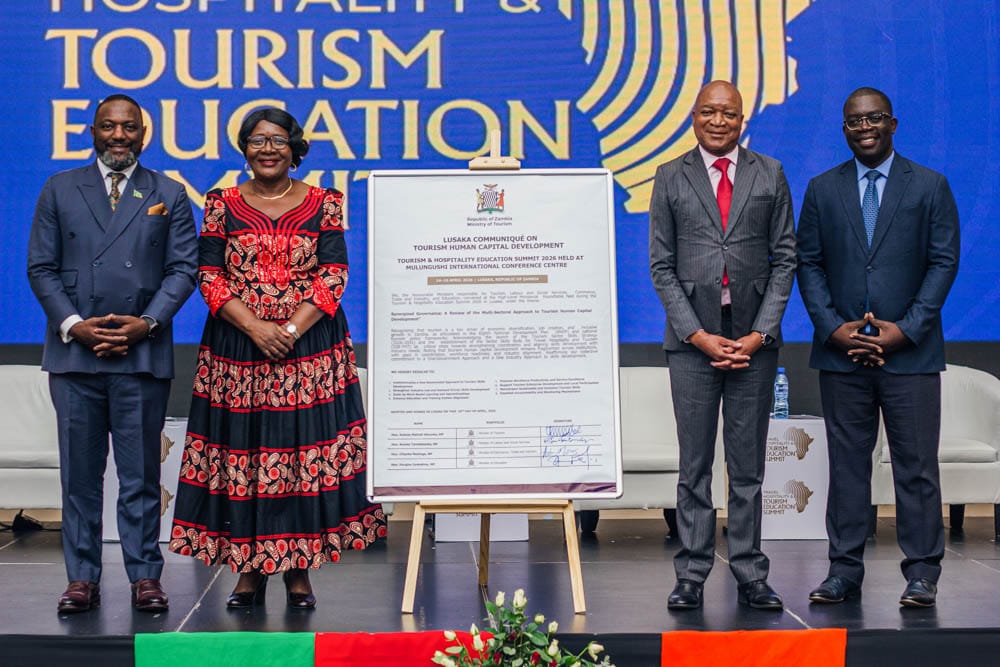
• Rodney Sikumba, Minister of Tourism
• Brenda Tambatamba, Minister of Labour and Social Security
• Chipoka Mulenga, Minister of Commerce, Trade and Industry
• Douglas Syakalima, Minister of Education
The session focused on strengthening alignment between education, labour, commerce, and tourism systems under a demand driven skills development framework.
Key discussions included curriculum alignment with industry needs, enhancement of workforce productivity, expansion of apprenticeship pathways, improved SME financing access, and simplification of tourism licensing processes to support investment and growth.
Each ministry outlined its role within the integrated framework, with Labour focusing on coordination mechanisms, Education on curriculum alignment, Commerce on enterprise financing and reform, and Tourism on implementation and sector integration.
A major outcome of the session was the signing of the Lusaka Communiqué on Tourism and Human Capital Development by the four ministers.
The communiqué formalizes a commitment to institutionalize coordinated governance in tourism skills development, strengthen inter ministerial collaboration, and align education systems with labour market needs.
It further commits government to expanding apprenticeship programmes, improving workforce productivity, enhancing service delivery standards, supporting tourism enterprise development, and establishing monitoring and accountability systems.
The summit also featured the announcement of 100 scholarships under the UN Tourism Online Academy, aimed at strengthening tourism education and professional capacity development.
The programme is designed to improve training delivery systems, enhance learning methodologies, and support institutional capacity building within the tourism sector.
Supporting sessions addressed vocational training systems, TEVET reforms, integration of indigenous knowledge into tourism education, and structured pathways for internships and apprenticeships.
The discussions reinforced the need for stronger alignment between education outputs and labour market demand, particularly within tourism and hospitality sectors.
The Ministerial Roundtable at the Travel, Hospitality and Tourism Education Summit 2026 in Lusaka marked a significant step toward institutionalized coordination of Zambia’s tourism human capital agenda.