
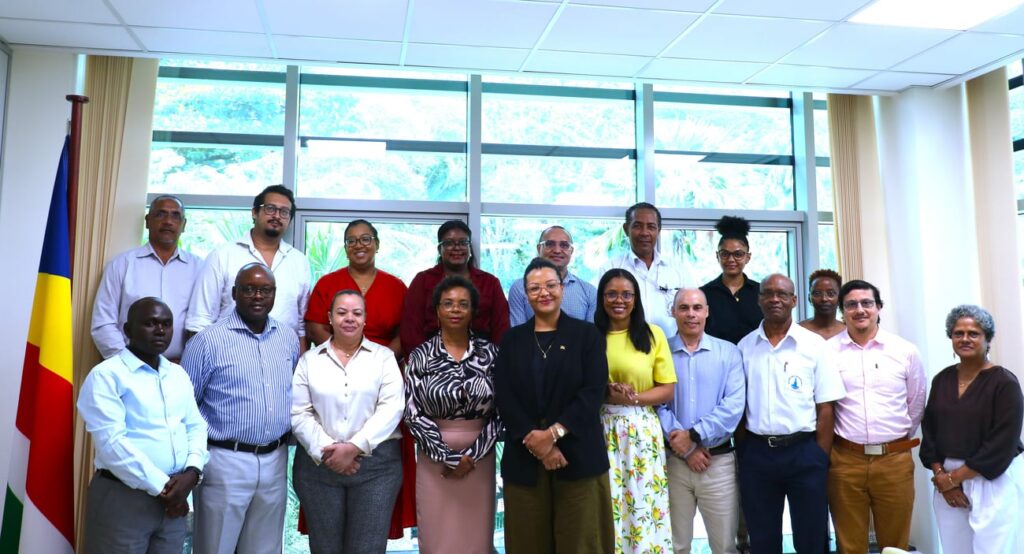
Following the stakeholder validation exercise on the Seychelles Cruise Tourism Strategy (2026–2033) with government leadership, the Department of Tourism and representatives from the United Nations Economic Commission for Africa (UNECA) outlined the key findings and strategic direction underpinning the document. The strategy marks the culmination of a two-year analytical and consultative process aimed at guiding the long-term development of Seychelles’ cruise tourism sector.
The process leading to this stage was completed with a Validation Workshop on the Seychelles Cruise Tourism Strategy held at the Savoy Hotel in Mahé in collaboration with UNECA. This was followed by a high-level presentation and handover session of the final strategy, attended by the Minister for Tourism and Culture, Amanda Bernstein; the Minister for Local Government and Inner Islands, Eveline Rose; principal Secretary for the Tourism Department, Sherin Francis, Principal Secretary for Energy and Climate Change, Tony Imaduwa; Principal Secretary for the department of Culture, Cecile Kalebi ; Principal Secretary for Investment, Michael Nalletamby; Principal Secretary or Civil Aviation, Ports and Marine, David Bianchi’s; and Principal Secretary for Blue Economy, Veronique Nibourette.
Both sessions were led by representatives from the United Nations Economic Commission for Africa (UNECA) Sub-Regional Office for Eastern Africa (SRO-EA), including Mr Geoffrey Manyara, Ms Rosemary Bagiza, and Mr Rayviscic Ndivo.
The strategy is grounded in a comprehensive cost-benefit analysis and extensive stakeholder consultations conducted since 2024, which found that while cruise tourism delivers significant economic benefits, including employment creation, foreign exchange earnings, and SME opportunities, it also generates notable environmental and social pressures that require careful management. These include impacts on marine ecosystems, infrastructure capacity, and community well-being linked to high-volume visitor arrivals.
Despite these challenges, the analysis confirms a net positive economic contribution from the sector, with stronger long-term gains achievable through improved coordination, strengthened regulatory frameworks, and increased local value retention. Estimates indicate that only a small proportion of cruise passenger expenditure is currently retained within the domestic economy, highlighting the need to deepen local linkages and reducerevenue leakage.
Building on these findings, the strategy sets out a framework to position Seychelles as a high-value, sustainable cruise destination, with priorities including upgraded port infrastructure, enhanced environmental safeguards, improved data systems for monitoring and planning, and greater participation of local businesses in the cruise value chain. It is supported by a proposed multi-tiered governance structure and an indicative investment requirement of SCR 2.32 billion, to be mobilised through a blended financing approach involving public funding, public-private partnerships, development partners, and industry contributions.
Speaking during the engagement, Principal Secretary for Tourism, Sherin Francis, said the strategy reflects a critical step in balancing growth with sustainability in the cruise sector.
“We have spent the last two years taking a closer look at the cruise sector to fully understand both its benefits and its costs. What the analysis has shown is that while the sector already contributes significantly to our economy, there are also real environmental and social impacts that must be addressed. The key message is that Seychelles stands to benefit even more if we organise ourselves better, by strengthening regulation, improving coordination, and ensuring that more of the value generated is retained within our economy and shared with our communities.”
The strategy is now set to guide the next phase of development and implementation of Seychelles’ cruise tourism sector in line with national sustainable development priorities.