

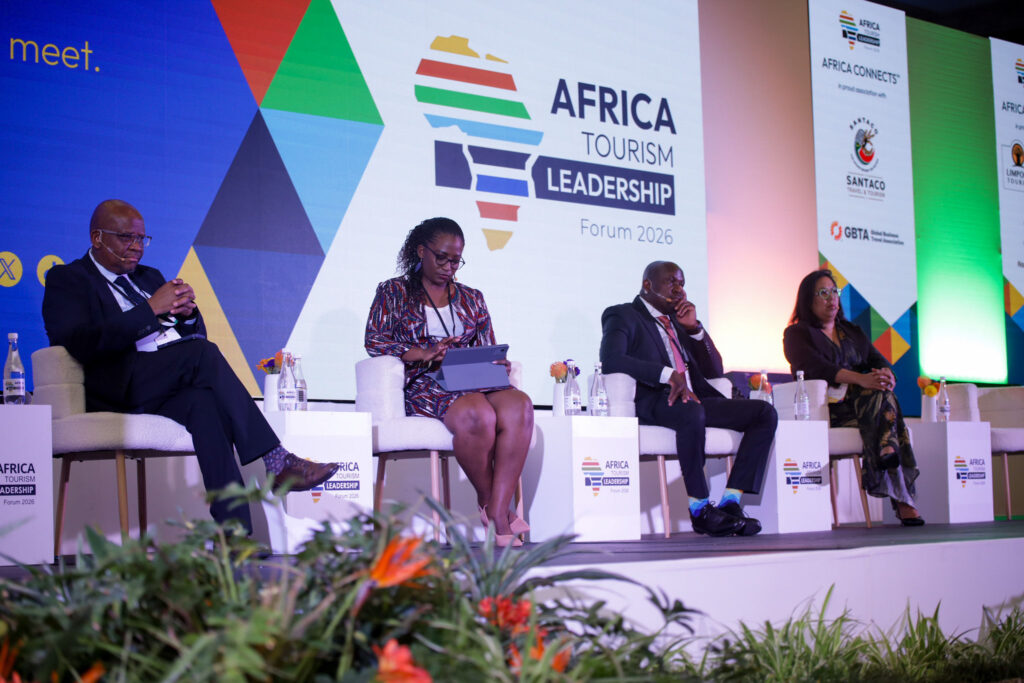
African tourism and aviation leaders have called for faster implementation of existing regional agreements, greater competition among airlines and more coordinated aviation policies as the continent seeks to expand intra African travel and unlock the full economic value of tourism.
The call came during the Business Leaders’ Dialogue at the 8th Africa Tourism Leadership Forum and Awards (ATLF 2026), taking place at Meropa Conference Centre in Polokwane, Limpopo, South Africa, under the theme, “Redefining the growth trajectory of intra Africa travel and tourism through thought leadership.”
The discussion brought together senior representatives from airlines, tourism agencies and industry bodies to examine air access, aviation protectionism, travel facilitation and the policy barriers limiting tourism and business travel across Africa.
At the centre of the conversation was a recurring concern: Africa has no shortage of agreements and policy commitments on connectivity, but implementation remains slow and uneven.
Tshifhiwa Tshivhengwa, Chief Executive Officer of the Tourism Business Council of South Africa (TBCSA), said bilateral arrangements between individual countries have often produced more tangible results than continent wide aviation initiatives.
He pointed to the continuing difficulty of implementing the Single African Air Transport Market (SAATM), which emerged from the Yamoussoukro Decision, despite the agreement being intended to liberalize African air transport markets.
The challenge, he argued, is not simply whether skies should be opened, but how countries can balance greater access with the survival and competitiveness of their domestic airlines.
Open skies can increase consumer choice and reduce barriers to entry, but Tshivhengwa cautioned that airlines with larger fleets and stronger financial capacity could dominate smaller markets if liberalization is not accompanied by fair competitive conditions.
For consumers, however, greater competition can bring significant benefits.
“If you have many supermarkets in one place and they’re all competing for my one rent, I’m the one who’s going to benefit,” Tshivhengwa said, using the comparison to illustrate how competition can work in the traveller’s favour.
The business environment surrounding aviation is equally important. Different levels of taxation, fuel prices, airport charges and regulatory requirements across African markets can make regional routes expensive and commercially difficult to sustain.
The discussion also exposed another less visible constraint: the ability of airlines to repatriate revenues earned in some African markets.
Tebogo Tsimane, Chief Commercial Officer of South African Airways (SAA), said currency disparities can significantly affect airline operations when revenues generated in one country lose value before they can be transferred back to the carrier’s home market.
“In some countries where the currencies are mismatched,” Tsimane explained, airlines can find that by the time funds are repatriated, “some of them you’ve lost half of what you generated.”
In some instances, he said, airlines are unable to repatriate funds at all.
For an industry operating on already narrow margins, such conditions can influence decisions about whether to maintain, expand or launch routes.
Tsimane argued that African aviation needs a more competitive operating environment, including fair regulations, fewer unnecessary taxes and charges, and conditions that allow airlines to compete on commercial rather than artificial terms.
He also made a case for African destinations to actively market one another.
As an airline serving the region, he said, carriers should be selling destinations across neighbouring countries rather than treating each market as an isolated commercial interest.
“I need to be marketing Zimbabwe. I need to be marketing Zambia as a South African carrier. We need to be marketing each other,” he said.
For tourism, that point is particularly important because air connectivity cannot be sustained by aviation alone. Airlines need passengers, while destinations need reliable air access to bring visitors into their markets.
Bronwen Auret, Chief Quality Assurance Officer in South Africa, described this as a two way traffic challenge. Attracting additional airlift is only part of the equation. Destinations and airlines must also generate sufficient demand to make routes commercially viable.
She pointed to the 2027 Cricket World Cup, which will be co hosted by South Africa, Zimbabwe and Namibia, as an opportunity for the three countries to work together to promote one another and stimulate regional travel.
Auret also challenged destinations to look beyond requests for airlines to add capacity and examine what they are prepared to contribute to making new routes viable.
That could include incentives from airports, businesses and tourism authorities, alongside demand stimulation through destination marketing.
From the tourism side, she said, the role is to help fill aircraft with visitors, while trade and business travel contribute to the wider passenger base.
The discussion placed particular emphasis on this relationship between tourism marketing and aviation development. An airline may have an aircraft available, but without sufficient demand, a new route can quickly become commercially unsustainable.
Abigail Shansonga, Acting Chief Executive Officer of the Zambia Tourism Agency, brought the discussion back to implementation.
Her message was direct: “Execution.”
Shansonga argued that African tourism has accumulated numerous ideas, policies and commitments, but too many remain unfunded or insufficiently implemented.
She called for governments and the private sector to work together on priorities that can actually be funded and delivered rather than continuing to expand lists of commitments without clear financing.
For Shansonga, intra African connectivity should be among those priorities.
She also pointed to Zambia’s decision to make at least 163 countries visa free, describing it as a major step that nevertheless demonstrated how much more can be done collectively, particularly within the Southern African Development Community.
Her strongest call was for African countries to move towards visa free access across the continent.
The debate also connected aviation access with the broader question of travel facilitation. Tshivhengwa questioned why a traveller who has already undergone extensive visa screening for countries such as the United States, United Kingdom or European Union should necessarily face completely separate processes when travelling between African countries.
The broader issue, he argued, is willingness among states to recognize and implement mechanisms that already exist.
That same implementation gap extends beyond aviation and visas. Tshivhengwa noted that African governments have repeatedly endorsed regional integration initiatives, yet commitments can falter when it comes to funding, regulatory alignment and execution.
He cited the former Regional Tourism Organization of Southern Africa (RETOSA) as an example of how regional cooperation can struggle when member states sign up to initiatives but do not consistently meet their financial obligations.
Beyond aviation: changing what Africa sells
The conversation eventually moved from how Africans travel to what Africa is selling.
Tshivhengwa argued that the continent’s tourism proposition remains too heavily concentrated around a narrow set of familiar products, particularly safari.
Africa has strong wildlife, beaches, adventure, food, hospitality, heritage and cultural assets, but these are not always presented as a sufficiently broad and interconnected tourism proposition.
The challenge, therefore, is both a connectivity problem and a destination positioning problem.
Better air access will make it easier for travellers to move between African countries, but the commercial case becomes stronger when those travellers have compelling reasons to visit multiple destinations.
This is where aviation, tourism, culture and the creative industries intersect.
Earlier discussions at ATLF 2026 examined the role of heritage, festivals, music, fashion and other creative industries in building stronger destination identities and creating commercial opportunities under the African Continental Free Trade Area (AfCFTA).
Emily Mburu-Ndoria, Director of Trade in Services, Investment, Intellectual Property Rights and Digital Trade at the AfCFTA Secretariat, also highlighted the importance of tourism within Africa’s economic integration agenda, linking areas such as visa openness and cross border investment to the expansion of the tourism economy.
The message across the sessions was consistent: tourism cannot be separated from trade, transport, investment and regional integration.
The policy question now is implementation
The aviation discussion at ATLF 2026 exposes a familiar contradiction in Africa’s tourism economy.
The continent has established institutions, signed agreements and articulated ambitions for greater integration, yet travellers and businesses continue to encounter fragmented systems, expensive airfares, restrictive market access, different tax regimes, currency constraints and visa barriers.
For airlines, these conditions affect route economics.
For tourism businesses, they affect market access and visitor volumes.
For travellers, they translate into higher costs, longer journeys and fewer options for moving between destinations.
The business case for reform is therefore broader than aviation. Better connectivity can support leisure tourism, MICE, trade, investment and intra African business travel, while greater competition can improve consumer choice.
But the panel also made clear that liberalization alone will not solve the problem. Governments, airports, tourism authorities, airlines and the private sector all have roles in creating commercially viable routes and ensuring that increased access produces two way traffic.
The 2027 Cricket World Cup, to be co hosted by South Africa, Zimbabwe and Namibia, provides one immediate platform for regional cooperation. The three markets have an opportunity to use the tournament to demonstrate how sport, tourism and aviation can work together to generate cross border movement.
Beyond major events, however, the more fundamental task remains policy execution.
Africa’s tourism industry does not need another long list of commitments without delivery. It needs countries to implement the agreements already made, address the cost structures that make regional aviation difficult, create fair competitive conditions and work collectively to generate demand across borders.
The direction emerging from ATLF 2026 is therefore clear: intra African tourism growth will depend less on producing another policy document and more on turning existing commitments into routes, visas, investment, products and actual movement of people.
For a continent seeking a larger share of its own tourism market, connectivity is no longer simply an aviation issue. It is an economic integration issue. The next test for African tourism leadership will be whether governments and industry can move from agreement to execution, and from protecting individual markets to building a stronger continental visitor economy.