
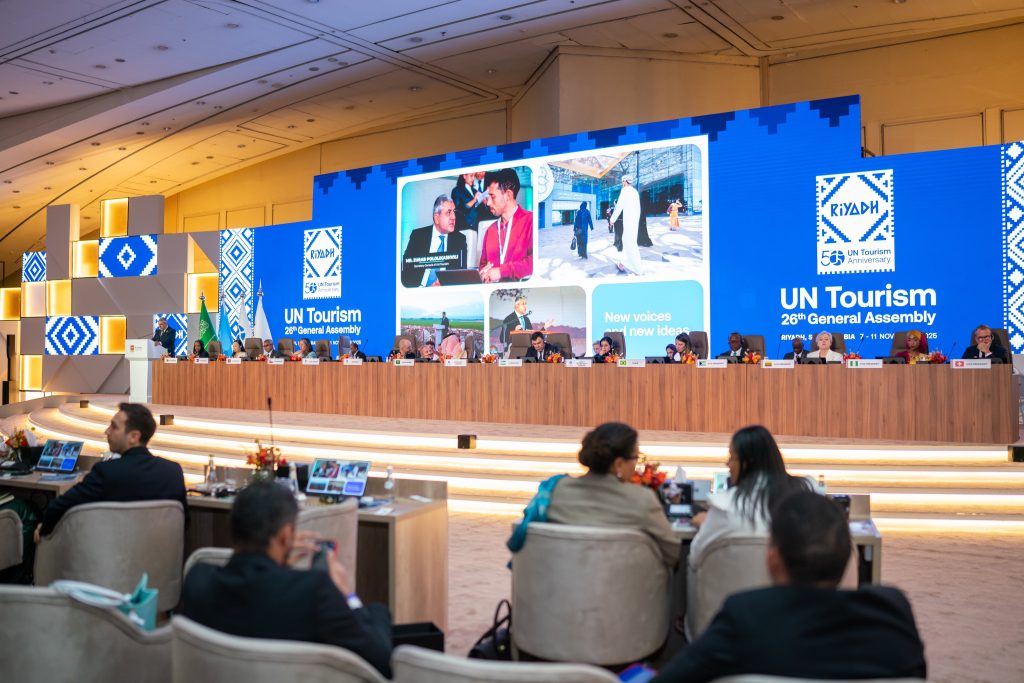
UN Tourism Secretary-General Zurab Pololikashvili opened the 26th session of the UN Tourism General Assembly in Riyadh on Sunday, striking a tone of gratitude, optimism, and purpose as he addressed delegates for the final time in his eight-year tenure.
The gathering, hosted by the Kingdom of Saudi Arabia under the leadership of His Excellency Ahmed Al Khateeb, has drawn ministers, heads of delegation, and tourism leaders from around the world to reflect on the progress of the sector and chart its next phase of growth.
In his remarks, Pololikashvili thanked Member States for their continued support, noting that this Assembly marked both a personal and institutional milestone. “It is a true honour to be addressing this esteemed Assembly as Secretary-General for one final time,” he said. “Some of you have been with me from the very start of my first mandate. Others have joined more recently. In all cases, I thank you for your support and your commitment to be here and be an active part of shaping our Organisation’s future.”
Saudi Arabia’s Tourism Transformation Commended
Pololikashvili paid special tribute to Saudi Arabia’s rapid transformation as a tourism destination and to Minister Al Khateeb’s leadership in driving Vision 2030. He recalled his first visit to the Kingdom more than six years ago during World Tourism Day, when the country had just launched its electronic visa system — a step he described as “the start of an incredible journey.”
“Today, tourism is a key sector of the Saudi economy,” he said. “It is a driver of Vision 2030, a top employer and an example for other countries to follow. It is expected that tourism will account for 10% of GDP by 2030, up from 3.5% just three years ago.”
He lauded Al Khateeb’s role in that transformation, calling him “a leader, a visionary, and a true ally and friend of our Organisation.” Pololikashvili added: “Like any good friend, he has supported us but also at times challenged us. And so, in front of this Assembly, I wish to thank him for his service to tourism and his commitment to unleashing the full power of our sector as a force for good.”
Facing Global Challenges with Optimism
The outgoing Secretary-General reminded delegates that the world continues to face formidable challenges, including the climate crisis, inequality, and global instability. Yet, he emphasised that UN Tourism’s enduring strength lies in its ability to find “opportunity in adversity.”
“This Assembly meets at a critical time for our economies and our societies,” he said. “There are challenges we cannot ignore — the climate emergency, inequality, insecurity, and a breakdown in international order and trust. But what makes this Organisation so special is that we find opportunity in adversity. And we always look to the future.”

Innovation and Education at the Heart of UN Tourism’s Agenda
Pololikashvili underlined innovation and education as key pillars of UN Tourism’s strategy. He pointed to the Regional Office for the Middle East, based in Riyadh, as a “true hub for supporting new talent and growing new ideas,” and noted that the Assembly’s Thematic Session on Artificial Intelligence will address “the most pressing topic for our sector today.”
He also recognised Saudi Arabia’s contribution to advancing tourism education globally. “The Kingdom is a firm believer in the power of tourism education to change lives and transform communities,” he said, thanking Minister Al Khateeb for his role in supporting several key UN Tourism initiatives:
- The Education Toolkit, now used in high schools worldwide;
- The Online Academy, which expands access to tourism education globally; and
- The recognition of Saudi Arabia as the country with the most institutions earning TedQual certification this past year.
A Stronger Organisation, a Shared Future

As he closed his final address to the General Assembly, Pololikashvili expressed pride in the strength of the Organisation and optimism for its future. “Our Organisation has never been stronger,” he said. “I look forward to a productive session, where all voices are heard and respected, and a spirit of cooperation shines through.”
The 26th UN Tourism General Assembly in Riyadh brings together delegates from over 160 Member States and serves as the last under Pololikashvili’s leadership. His successor, Shaikha Al Nowais of the United Arab Emirates, was nominated by the Executive Council in May 2025 and is expected to assume office in January 2026, pending ratification by the Assembly later this week.
As UN Tourism marks its 50th anniversary, Pololikashvili’s remarks set a forward-looking tone for an Assembly poised to bridge legacy and innovation — ensuring that tourism remains a force for good and a pillar of global cooperation in a rapidly changing world.
Key Highlights from Zurab’s Opening Speech
A Farewell with Gratitude
In his final address as Secretary-General, Zurab Pololikashvili thanked Member States for their support throughout his two terms and urged continued unity and cooperation in shaping the Organisation’s future.
Saudi Arabia’s Tourism Transformation Praised
He commended the Kingdom of Saudi Arabia and Minister Ahmed Al Khateeb for transforming the nation into a model for tourism-led economic diversification, calling it “a true example for others to follow.”
Challenges and Opportunities Ahead
Acknowledging global challenges — from climate change to inequality — he urged delegates to maintain optimism, innovation, and trust, noting that UN Tourism “finds opportunity in adversity.”
Innovation and Education as Priorities
Pololikashvili highlighted the growing importance of innovation and education in tourism’s transformation, referencing the Regional Office for the Middle East as a “hub for new ideas” and praising Saudi Arabia’s leadership in supporting global tourism education and TedQual-certified institutions.
A Stronger, More Connected Organisation
He concluded that UN Tourism has “never been stronger,” expressing hope that the Assembly will be remembered for