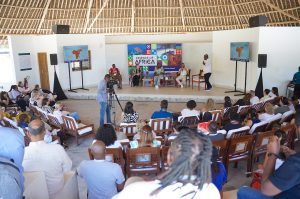


Ghana has used WTM Africa in Cape Town to reinforce its commitment to growing intra-African tourism, strengthening business travel and positioning itself as a competitive destination for meetings, incentives, conferences and exhibitions (MICE).
Speaking on the sidelines of the trade show, Ekow Sampson, Deputy CEO in charge of Operations at the Ghana Tourism Authority, said Ghana’s participation at WTM Africa is rooted in the belief that Africa must first trade tourism among itself.
According to Sampson, Ghana has historically played a leadership role in fostering African tourism relationships, and platforms such as WTM Africa provide the ideal environment to deepen business-to-business engagement across the continent.
“Africa is our natural market. When you consider our population, shared heritage and long-standing relationships, we really do not need to look elsewhere first. WTM Africa allows us to have those conversations among ourselves and grow African tourism from within,” he said.
Strengthening Business, Heritage and Intra-African Tourism
Sampson explained that Ghana’s engagement at WTM Africa goes beyond leisure travel. The country is deliberately growing its business tourism and heritage travel segments, building on close cultural and historical ties with other African nations and the wider diaspora.
He noted that Ghana’s presence at MICE-focused platforms across the continent reflects a strategic decision to capture a greater share of Africa’s meetings and conventions market. While infrastructure remains a work in progress, Ghana is actively leveraging existing hotel facilities and planning for larger, purpose-built venues.
“We have experience in hosting major events, dating back to the early 1990s when Ghana hosted international conferences. Today, we are looking ahead to developing convention centres that can host conferences of 10,000 to 20,000 delegates,” Sampson said.

Strengthening Business, Heritage and Intra-African Tourism
Sampson explained that Ghana’s engagement at WTM Africa goes beyond leisure travel. The country is deliberately growing its business tourism and heritage travel segments, building on close cultural and historical ties with other African nations and the wider diaspora.
He noted that Ghana’s presence at MICE-focused platforms across the continent reflects a strategic decision to capture a greater share of Africa’s meetings and conventions market. While infrastructure remains a work in progress, Ghana is actively leveraging existing hotel facilities and planning for larger, purpose-built venues.
“We have experience in hosting major events, dating back to the early 1990s when Ghana hosted international conferences. Today, we are looking ahead to developing convention centres that can host conferences of 10,000 to 20,000 delegates,” Sampson said.
From December in GH to a Year-Round Destination
On the leisure tourism front, Sampson pointed to Ghana’s consistent growth over the years, driven by intentional cultural programming and sustained destination marketing. Initiatives such as December in GH have repositioned the country as a vibrant holiday destination, attracting diaspora visitors, creatives and festival-goers who immerse themselves in music, arts, culture and lifestyle experiences.
However, Ghana’s ambition now extends well beyond a single peak season. “Our focus is to ensure that from January to December there is always something happening. Every month should offer a product, an activation or an experience that draws visitors into the country,” he explained.

This year-round approach is aimed at reducing seasonality, supporting tourism businesses and creating consistent opportunities for visitor engagement across festivals, heritage events, eco-tourism and creative industry platforms.
Anchored by the Black Star Experience
Central to this strategy is the Black Star Experience, the government-led framework designed to position Ghana as Africa’s leading cultural, heritage and lifestyle destination.
Sampson described the Black Star Experience as the unifying vision that brings together tourism, culture, creative arts, gastronomy, fashion and business events under one coherent national brand.
“The Black Star Experience gives structure to what we are doing. It ensures that our festivals, heritage tourism, creative programmes and business events are aligned, and that every month of the year offers a distinct experience,” he said.
By integrating flagship initiatives such as December in GH, heritage commemorations and emerging business tourism platforms, Ghana is building a unified narrative that appeals both to African travellers and the global diaspora.
The framework also strengthens Ghana’s MICE ambitions by blending business events with rich cultural and lifestyle experiences – an increasingly important consideration for international conference organisers.
A Complete Destination Offering
Summing up Ghana’s tourism proposition, Sampson described the country as a destination with a broad and diverse offering. “Ghana is like a buffet. You have culture, heritage, eco-tourism and business tourism all in one place. We do not limit ourselves. When you come to Ghana, you experience everything,” he said.
As African tourism increasingly looks inward for growth, Ghana’s message at WTM Africa was clear – deeper intra-African collaboration, strategic investment in MICE infrastructure and year-round experiential tourism will define the continent’s next phase of growth, with Ghana positioning itself firmly at the centre of that journey.