


Hamza Farooqui, Founder of Millat Global in South Africa, set out a compact but forceful case for why South Africa is positioned to play a leading role in Africa’s hospitality renaissance. Speaking from experience at the UAE-Africa Tourism Investment Summit, he framed the challenge for the continent as one of scale, predictable execution, and investor confidence, and he described the practical steps his organisation is taking to convert promise into proven performance.
Farooqui opens with a simple premise, that travel thrives where there is base business, and that a reliable domestic market is the single most important buffer against external shocks. South Africa, he argues, benefits from a robust domestic travel sector, with sizeable local demand for coastal and urban destinations such as Cape Town and Durban. By contrast, he says, other markets, Morocco among them, remain overly dependent on proximate international demand, and therefore more vulnerable to sudden shocks in source markets.
This domestic resilience is the first plank of Millat’s argument, because predictable local demand allows operators to build businesses on firm foundations, rather than on “shifting sands.” The second plank is scale, which Farooqui defines as the capacity to knit together supply chain, distribution, and capital at levels that matter to institutional investors. He is uncompromising about the limits of piecemeal projects, saying that one or two hotels here and there will not change the structural investment calculus. Institutional capital, he notes, looks for scale, track record, and predictable governance, and Africa must present those credentials to attract serious global funds.
Millat’s practical response is to build a demonstrable operating platform, rather than to ask for capital without capability. Farooqui outlines a deliberate strategy of developing, owning, and operating globally branded hotels, and of assembling the operational expertise required to work with major brands. In his view, hotel flags alone cannot solve the Africa equation. Success requires an integrated thesis covering domestic market dynamics, distribution channels, technology stacks, and capital formation. Only with those elements in place can hotel openings translate into a resilient, investible business.
A recurrent theme in the conversation is the perception of elevated risk among global institutional investors. Farooqui acknowledges that this perception exists, and he attributes it in part to fragmentation and a “half-hearted” approach to the sector across the continent. Fragmentation, he explains, creates transaction-by-transaction risk, while a unified, corridor-based approach would lower the perceived premium by demonstrating repeatable, scalable outcomes. He draws an instructive parallel with Dubai, noting that Dubai’s success was not simply the result of destination marketing, it was the product of an integrated aviation, infrastructure and policy strategy that connected markets and created consistent movement.
Political and regulatory uncertainty is another real concern raised during the discussion. Farooqui’s response is pragmatic, informed by long operational experience. Entrepreneurs, he says, should focus on execution and avoid overreliance on political engagement, while recognising that enabling public policy has a role to play. He insists that governments who want to attract foreign direct investment and lift GDP will ultimately need to reduce policy uncertainty, and align regulations to enable private capital and delivery partners.
Women and youth, and the broader demographic trends, anchor Farooqui’s optimism about demand growth. He points to Africa’s young, increasingly mobile population and a growing middle class that will tilt future tourism flows toward the continent. This demand thesis, combined with better air connectivity, is central to his view that Africa is a prospective growth frontier for hospitality investors.
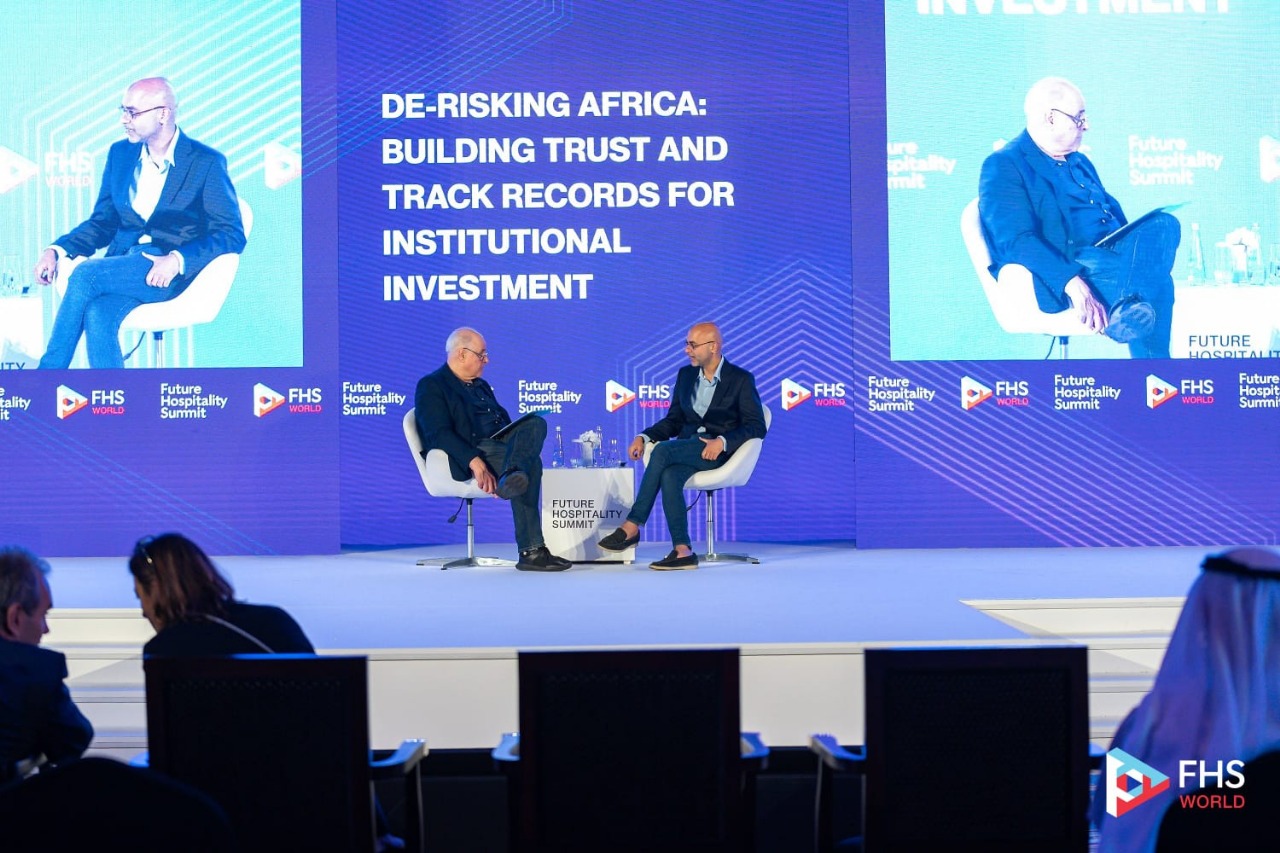
Hamza Farooqui (Right) with Jeremy Maggs on stage at the recent FHS event in Dubai
Air access, he concedes, remains a significant structural constraint, particularly for intra-Africa movement. Complex routings and limited inter-hub services make regional travel inefficient. Farooqui highlights the role of major Gulf carriers and emerging national initiatives to fill this gap, while noting that longer-term improvements in aircraft capability and route economics will also be important. For Farooqui, improving airlift is both a precondition for scale and an opportunity for regional coordination.
On technology and distribution, he expects rapid change over the next three to five years. Agentic and discovery-driven artificial intelligence will reshape how travellers find hotels and experiences, reducing dependence on the traditional online travel agency model. Farooquianticipates that operators who combine compelling product, local supply chains, and a modern technology stack will capture greater direct distribution and margin, strengthening the investment case.
Transparency and data are another priority for Millat. Farooqui is explicit that Africa underperforms on reliable, standardised industry data, which makes the region opaque to large allocators. His recent involvement with the World Travel and Tourism Council is intended to help mobilise better data and to elevate Africa’s investment narrative. For him, the shift from “awareness” to “evidence” will be decisive in turning tentative interest into committed capital.
What will convince sceptical global managers? For Farooqui, the answer is conviction, demonstrated through execution and scale. He argues that capital must be deployed with intent, not on a tentative or charitable basis. The single transformative signal, he suggests, would be the arrival of major global asset managers such as BlackRock or Brookfield en masse, because their participation would amount to an immediate compression of the continent’s perceived risk premium.
Throughout, Farooqui grounds his strategy in operational proof points. Millat has focused on building a track record by operating branded assets, by understanding local procurement and technology requirements, and by forming the institutional muscle to deploy capital responsibly. The explicit objective is to move from laboratory experiments to an investible, repeatable thesis that demonstrates returns at scale.
The practicality of this agenda, and its transferability across the continent, will depend on coordinated public and private action. Governments must create clearer tenure and regulatory frameworks, airlines and aviation policy must prioritise connectivity, and investors must be prepared to commit patient capital alongside operational partners with local expertise. Where those pieces align, the combination of domestic demand, improving air access, and disciplined execution can create the conditions for a credible, long-term hospitality growth story.
Hamza Farooqui’s account is, above all, a blueprint for converting aspiration into evidence. It foregrounds domestic resilience, disciplined platform-building, transparent data, and an insistence on scale as prerequisites for institutional capital. For South Africa, and for wider corridors of inter-Africa travel, Millat’s thesis offers a pragmatic route from opportunity to outcome, provided public policy, private conviction, and operational rigour coalesce in measurable ways.