

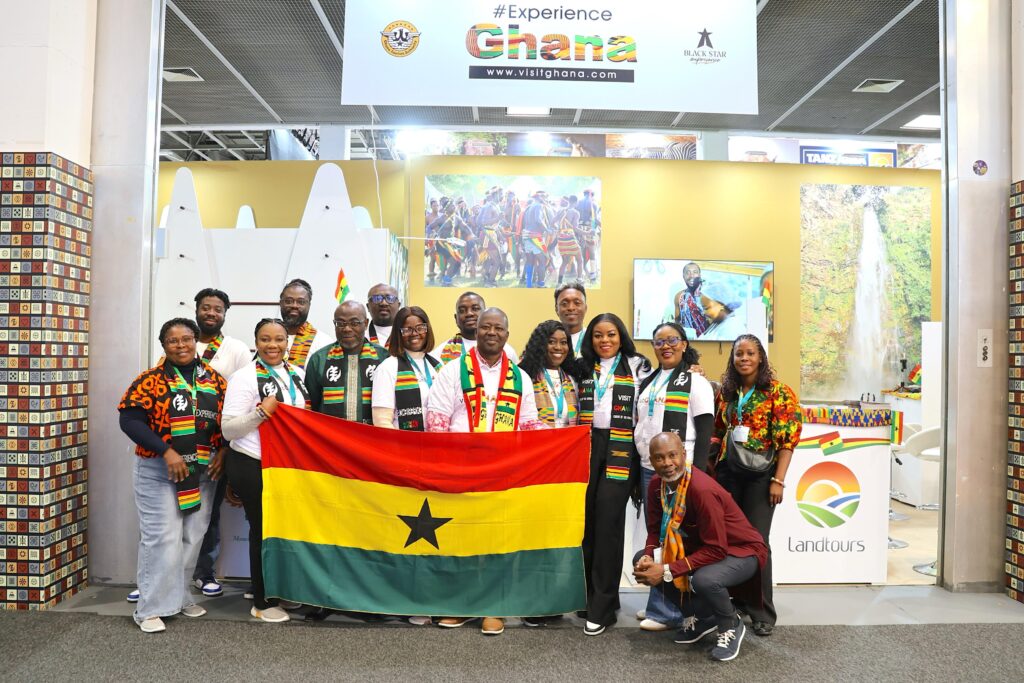
Ghana has reaffirmed its position as one of Africa’s most promising tourism destinations after making a strong impression at the 60th anniversary edition of the ITB Berlin, held from 3–5 March in Berlin, Germany.
The globally renowned travel and tourism exhibition—widely regarded as one of the industry’s most influential marketplaces—brought together thousands of exhibitors, tour operators, destination marketing organisations, and travel professionals from across the world to showcase tourism products and forge new partnerships.
Representing Ghana at the landmark event was the Ghana Tourism Authority (GTA), which mounted an exhibition highlighting the country’s diverse tourism offerings, ranging from cultural heritage experiences and historical landmarks to pristine beaches and eco-tourism sites. The Ghana pavilion also featured several private tour operators who joined the national tourism body in promoting Ghana as a premier travel destination.

Ben Anane-Nsiah, Deputy Chief Executive Officer in charge of General Services, GTA
Leading the Ghanaian delegation was Ben Anane-Nsiah, Deputy Chief Executive Officer in charge of General Services at the GTA. In an interview with VoyagesAfriq on the sidelines of the exhibition, Anane-Nsiah emphasised the strategic importance of ITB Berlin for destinations seeking to expand their global tourism footprint.
He described the event as indispensable for serious tourism players seeking to strengthen industry connections and track emerging travel trends.
“ITB, for any serious tourism destination, is a must-attend event because all the players are there,” Anane-Nsiah explained. “The tour operators you deal with, the destination management companies, and organisations like UN Tourism and other stakeholders who advise on trends are all present. It becomes a one-stop shop where you can meet everyone you need in the ecosystem to help move your industry in the direction you want.”
Beyond its global reach, Anane-Nsiah stressed that Germany remains an important source market for Ghana’s tourism sector. While Ghana traditionally attracts strong visitor flows from the United States—largely driven by diaspora and heritage tourism—the European market continues to play a significant role in visitor arrivals.
“The German market in Ghana is quite important,” he said. “Traditionally, we focus a lot on the U.S. market because of the ethnic traffic and heritage connections, but if you look at our statistics, the United States, Britain, and Germany are key markets.”
Providing an example, he noted that Ghana’s embassy in Germany issued approximately 14,000 tourist visas last year, demonstrating sustained interest among German travellers.
“If you look at what they like to do when they come, they are particularly interested in our eco-sites, our beaches and other natural attractions. It is a market we simply cannot ignore.”
Anane-Nsiah added that ITB Berlin serves as a gateway not only to Germany but to the entire European travel trade.
“ITB is even bigger than just the German market—it represents the whole of Europe and many other regions,” he said. “That is why it is important for us to be here. We must keep Ghana in people’s minds, showcase what we are doing, and also get feedback from the market so we can tweak our products to better meet travellers’ needs.”

Despite the positive reception Ghana receives internationally, the GTA official acknowledged that certain travel barriers continue to affect the country’s competitiveness.
One of the most significant concerns raised by international tour operators and travellers is the visa acquisition process. According to Anane-Nsiah, Ghana must modernise its entry procedures to remain competitive with neighbouring destinations.
“Generally, the challenge with visa acquisition is a problem,” he admitted. “Many of our competitors—countries like Senegal and Benin—have quickly moved to e-visas or visa-free systems. But for some travellers to Ghana, they still have to mail their passports to the embassy and wait for the visa to be processed and returned. That becomes a major obstacle.”
He expressed optimism that the long-anticipated electronic visa system will finally be implemented this year, noting that the initiative was referenced in the President’s recent State of the Nation Address.
“We have been discussing e-visas in Ghana for several years, and we are confident that this year it will finally be executed. Once that obstacle is removed, more travellers will certainly consider Ghana as a convenient and attractive destination.”
Another issue under review is the requirement for yellow fever vaccination certificates for travellers from countries that are not considered endemic zones.
“For visitors who are not coming from yellow fever endemic areas, this requirement is something we must look at again,” he noted. “Any unnecessary hurdle placed in front of travellers must be weighed against what our competitors are doing. The goal is to make it easier for people who want to visit Ghana.”
Despite these challenges, Anane-Nsiah said feedback from international partners remains largely positive. Visitors consistently praise Ghana’s safety, welcoming atmosphere and the variety of experiences available—from heritage tourism linked to the trans-Atlantic slave trade to nature-based adventures and beach holidays.
However, he also acknowledged concerns regarding price sensitivity, especially during peak travel seasons.
“Some of our prices during the high season can become a disincentive for travellers,” he explained. “That is something we need to work on together with our private sector partners so that Ghana remains competitive.”
The Ghana Tourism Authority is implementing a series of strategies aimed at sustaining growth in visitor arrivals and strengthening the country’s tourism ecosystem.
Ghana recorded 1.3 million international arrivals in 2025, a milestone that tourism authorities are keen to build upon.
One of the key initiatives involves leveraging global sporting events to promote Ghana abroad. With the upcoming FIFA World Cup generating worldwide attention, the GTA plans to undertake promotional activations in several American cities.
“We want to grow our numbers by taking advantage of our participation in the World Cup,” Anane-Nsiah revealed. “We will organise city activations in the United States in collaboration with our cultural sector—musicians and other creative industry players—to draw attention to Ghana in four or five major cities.”
Another priority is strengthening domestic tourism, particularly during major holiday periods. Authorities are working to expand the popular Easter tourism experience beyond the well-known festivities in the Kwahu area to other destinations across the country.
“We want to make Easter celebrations more vibrant in multiple destinations, not only the traditional Kwahu area,” he said, explaining that this strategy will help spread economic benefits to other regions.
Capacity building within the local tourism industry also remains a critical pillar of the GTA’s strategy. According to Anane-Nsiah, the Authority will intensify training programmes for tour operators, hospitality workers, and other stakeholders to enhance service quality and professionalism.
“We are going to focus strongly on capacity building—training our operators, offering refresher courses, and strengthening the skills of people within the industry,” he noted.
“These are the strategies we are adopting to consolidate the gains we have made so far and ensure that Ghana continues to grow as a leading tourism destination,” Anane-Nsiah added.
Click here to view more images